Tuesday, June 15, 2010

White Lightin' and Ron Ellis

Interview with Ron Ellis conducted March 2010.

In 1966, at the young age of 14, Ron Ellis was a student by day and a rock and roller by night. "I was in different groups around town," he said. "I was in one called The Tangerine Dream, but later we found there was already a band called that. We thought it as original. We were playing Rolling Stones songs, primarily."

But the Pueblo teen guitarist's career took a different turn when his parents divorced, and he moved to California with his mother. Soon after they arrived, a tragic car accident took the life of his mother. Ron found himself back in Colorado. He enrolled at Pueblo East High School.

Around this time Ron, and his older brother Joe, picked up where they left off, and started playing around town. When they didn't have a gig, they would catch one of their favorite groups, the Trolls.
"We always thought if we could get one of the Trolls in our group that would be incredible - those guys were like the Rolling Stones in Pueblo," he said. "They were huge."


Taking their cue from bands such as the Rolling Stones, and the Kinks, the Trolls blend of British rock gave them local superstar status. Led by singer/guitarist Richard "Speedy" Gonzales, organist Fred Brescher, drummer Phil Head, bassist Monty Baker and lead guitarist Doug Rymerson, the Trolls issued a couple of 45s ("That's the Way My Love Is" / "Into My Arms" Ruff 1010 - 1965 and "Stupid Girl" / "I Don't Recall" Warrior 173- 1966). After attempting to make it big in California, the group disbanded in 1967.

After the band broke-up, Richard Gonzales put away his guitar, stayed on the West Coast, settled in to married life...and a regular paycheck.

"We had met Speedy's brother Leroy, who played drums. He said 'I know my brother will want to play with us,' so we went to California to ask him to be in our band," Ellis said. "Speedy’s wife wasn’t happy that he wanted to be in another group, and he was reluctant. He had a nine-to-five job and had given up the whole music thing."

But he changed his mind.

With the line-up complete, the foursome of the Ellis and Gonzales brothers moved back to Colorado, and under the guidance of local manager Tony Spicola, quickly made a local name for themselves as White Lightnin'.

"Speedy named the band," Ron Ellis said. "We were just kidding around and then we found out there were a number of bands named that."

A local nightclub owner, as well as media and public relations mogul, Tony Spicola saw potential with the group. He knew the next step was to get them in the recording studio. "He thought it would be good for his club attendance if we had a record to sell."

In 1969, just after Ron Ellis graduated from East High School, Spicola booked Norman Petty Studios, in Clovis, NM.

"I kinda knew who Norman Petty was," said Ellis. "We walked into to the studio, it was a great studio. He bought an old movie theatre and you would record on the stage. In the projection booth was the recording equipment."

After playing several songs for Petty, the producer decided on two for the band's single - "Leaves" and "Blue Man (Peace of Mind)."


Listen to "Blue Man (Peace of Mind)"

"When we were out in California, we were doing some gigs, but the guy at the club wouldn't pay us," said Ellis. "There was a person who lived nearby and said if we rolled 200 "whites" for him in tin foil he would give us 50-bucks. Leroy and I jumped in and started doing it. When we left the guy said 'Take as many as you want,' and I took some of them. After we left his house the police stopped us and took us in – those were the blue men. We were put in a room and interrogated. They called home in Colorado and then released us."


"Leaves is a very personal song for me," Ellis said. "When my parents divorced and I moved to California with my mother, she was involved in a head-on collision, and died. I have a recollection of that being in the autumn. I looked around at the leaves dying and just wrote it–there aren't a lot of lyrics, it's mostly feeling. While recording "Leaves," Norman Petty added strings to the arrangement.

"We listened back and really didn’t envision that as part of the song - so we took it out." After a successful recording session, the band headed back to Colorado - but Tony Spicola had other ideas for Ron Ellis. "We took separate cars. I rode with Tony," Ellis said. "He showed me a contract, and told me that he wanted to work with me as a solo artist. I told him that I wasn't interested because my brother was in the band. It was kinda funny, Tony christened me with this name, I don't remember what it was, but that was going to be my new stage name."

Released in January 1970, on the band's own Sandoz label (Speedy Gonzales named the label after Eric Burdon's "A Girl Named Sandoz"), the record received extensive airplay throughout Colorado.

"We also played a lot of gigs," Ellis said. "But then Leroy started acting weird, and it was pretty embarrassing. He would play drum solos with his head - and we knew it was time to end the band."

For Ron Ellis' second act, he decided to go back to school. "I thought it would be a good idea for me to learn music," so I started taking classes at USC [University of Southern Colorado]," he said. "Joe and I went on to form The Ellis Brothers, and then we got together with [former Trolls member] Phil Head and formed Waco." After Waco, Ellis found success in The Cows. "That was a fun group because for once I didn’t have to carry the show," he said. "We were kinda like Alice Cooper on fire - real crazy. We were playing Mothers of Invention type stuff. We played in the Springs and the mountain towns - but we only did that for about six months."

Ellis graduated from USC, and was offered a job there teaching classical guitar. "My brother thought I snubbed the whole rock world," he said. He would go on to write a ballet, entitled Repetition, which would be performed at the local Sangre De Cristo Art Center. Moving to Albuquerque to pursue his master's degree in music, he came back to Colorado, and is currently teaching music at a Colorado Springs middle school.

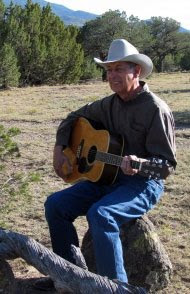
Ron Ellis (2010)

Joe Ellis moved back to California, and plays bass for the group Blues Highway. Attempts to contact Richard Gonzales were unsuccessful. Numerous sources indicated that Leroy Gonzales passed away, but this is unconfirmed. "For me, Eric Clapton and all of those guys entrenched themselves in that rock lifestyle, but I really didn't feel that it was part of what I should be doing," Ellis said. "I came out of it pretty unscathed."  

COMING NEXT POST: The Narrow Gauge Line

Tuesday, June 1, 2010

Bob Mickey

Interview with Ida Mae Mickey, Marcella Mickey, Jean Hasty and Eugene Birt conducted March 2010.

Bob Mickey's parents came to the La Junta area in 1916, where they homesteaded south of town. Moving into La Junta proper in 1921 he was born two years later, in a family who as spent as much time in church as they did working the farm.

But Bob Mickey had other ideas.

"He never wanted to settle down," said his sister Jean Hasty. "He followed his older brother to California, and worked at the Swift packing plant, and didn't like it, so he started driving a taxi, and then one day he took his guitar to a bar, and started playing."

Throughout the 1940s, Mickey would find himself in every honky tonk on the West Coast, playing for tips. After introducing himself to Tennessee Ernie Ford, he would go on to appear on the star's radio show, and pitch a song to the singer that he a recently written.

The song was called "All I Want for Christmas," said Hasty. "Ford went on to record it, and for the longest time Bob would get these little residual checks from that record."

For the next decade, Mickey kept busy working the bar circuit, but a trip back home to Colorado in 1953, before a booking in Santa Fe, would forever change his life.

"My mother invited him to go to church," said Hasty. "During the service he became converted. He called the bar in Santa Fe and told them that his life and priorities had changed, and he wasn't going to make the show."

Almost immediately the western-attired preacher became an in-demand evangelist, sharing his testimony at revivals. The nightclub audience he once played to for tips was replaced with packed believers who wanted to hear how this former honky-tonker found the Lord.

In 1954, friends attempted to set him up with Esther Mae Roberts - but he had his eyes on her cousin, 24-year-old Ida Mae, a Lamar chalk artist who often used her artistic talents to portray Bible scenes during church services.

"My parents were good Christians, and they knew that God forgives you, so they didn't have any problems with him and his past life," Ida Mae said.

The two married February 14, 1955.

"Bob was working with an evangelist and taking a correspondence course to become a preacher," Ida Mae said. "We went on a short honeymoon, and then started doing revivals together."

Jewell County Record – Superior, Kansas
March 30, 1967

Bob and Ida Mae would live out of a suitcase the first few months of their revival career, staying in church Sunday school rooms, or in a pastor's home. Realizing they needed to expand their living conditions, with the arrival of their daughter Marcella (in 1959), they purchased a trailer.

Coming back to Lamar for the birth of their daughter, the Mickey family went back on the revival circuit just three weeks after she was born.

After ten years on the road, in 1969, the Mickeys came back to Lamar, in part so Marcella could attend elementary school. They continued to travel during the summer. By 1975 the family again hit the road full-time, home schooling their daughter, who would go on to become a licensed practical nurse.

While touring California, Mickey recorded Country Gospel (Crusade 584). Released in 1974, the album contains numerous religious standards, a cover of Hank Williams' "I Saw The Light," and one Bob Mickey original composition, "It's Later Than You Think."

Listen to "It's Later Than You Think"
"The picture on the album cover was chosen because my grandfather had homesteaded south of La Junta and the cedar breaks on the front cover look like their homestead site," said Mickey's daughter, Marcella.

In 1991, after nearly four decades on and off the road, Bob Mickey returned to the Lamar area, where he pastored in and around southeastern Colorado, including the Holly Nazarene Church.

"He was a very good pastor," said current pastor Eugene Birt. "You never saw him without his cowboy hat on - except in the church building."

In 2001 Mickey was planning a trip to Seattle to celebrate his sister's 66th wedding anniversary, when his health began to decline from years of diabetes and heart failure. Just three days before he was to leave, he died.

He is buried in Lamar.

COMING NEXT POST: White Lightnin'

Saturday, May 15, 2010

Sam Bachicha

Sam Bachicha interviewed February 2010.


Growing up in Branson, Colorado (pop. 77) – located a literal stone’s throw from the New Mexico state line, and about an hour from the nearest big city, Trinidad – forced Sam Bachicha to create his own entertainment.

“I used to hunt for arrowheads, and go rabbit and deer hunting,” he said.

His father would entertain the family, playing a variety of string instruments, but a freak accident nearly brought an end to the music.

“He worked on the railroad, and one day while unloading rail, he accidentally got a finger on his left hand caught under a sliding rail, and about one inch of his finger was severed. After the remaining part of his finger healed, he tried playing the guitar, but it was very painful for him.”

His father decided to sell his guitar.

“Some time later, he borrowed that same guitar for a few days. When he started playing and singing, I sat right there and listened until he stopped. I loved it. I asked him to teach me. He showed me how to place my fingers for an open D chord, which was one of the easier chords to reach for a small hand.”

When his father returned the guitar, he went out bought his son his own.

“A few months later I was asked to play at a PTA meeting. I sang and played “Jambalya.” At the conclusion of my song, the people would not stop applauding. My mother went back stage and said, ‘They want you to sing another one,’ but I just started to learn how to play and only knew one other song.”

So his encore was “How Much is That Doggie in the Window.”

Throughout high school, he would attend dances held across Las Animas County – reinforcing his decision to pursue a career in entertainment. “I would go see Roy Green’s Frisco County Ramblers, La Junta’s Sunflower Valley Boys [featuring Lloyd Hall on vocals], and the Nightriders, out of Raton.”


Branson School

After graduating Branson High School in 1957, he set off for the U.S. Air Force. His talents as a performer entertained officers in Washington, D.C., until he left the service in 1965. When he returned home to Colorado he found work at Taylor’s Supper Club in Denver.

“We had a Las Vegas style comedy and musical performance group, called Synchrony.”

In 1971, the group, which included Bev Morgan, Jay Salam, Terry Ewbank, and Doug Winegar, released the LP Our Album (Signet ST-710414). Songs included their versions of covers, including "Down on the Corner" and "MacArthur Park," as well as a Neil Diamond medley.


In 1980, Bachicha came back home to Southern Colorado, settling in Trinidad. While he became a real estate agent, he also found steady work as a performer. Preparing for a concert in front of a hometown audience in Branson, he decided to write a song about his upbringing in the rural area. Not to slight his new home, in Trinidad, he proceeded to write a similar anthem. In 1983 he recorded both.

Listen to "Branson"

Listen to "I Like Trinidad"

“I recorded at Jay Salem’s studio up in Denver. I worked with him when we were both in Synchrony. I played bass and rhythm guitar, and he played the guitar. We used a rhythm machine for the drums.”

He named his label Transac – the name of his real estate company, and short for transaction. The record was sold at Virgil’s Record Store in Trinidad, and during his live performances. While all 2000 copies of the record sold out, he never considered sending it to a major record label.

“It’s kind of hard to break into that business, so I really didn’t even try.”


Sam Bachicha

At 70, Bachicha shows no sign of slowing down. Currently he appraises real estate, and continues to perform throughout Southern Colorado.

“I did about 106 dates last year – about nine dates a month. I keep pretty busy,” he said. “I still love it. I want to play and sing until I am no longer able to do so, or no one wants to hear me anymore, which ever comes first.”

He is in the process of recording a full length CD of 15 original songs.

Saturday, May 1, 2010

John Overton

Interview with John Overton conducted January 2010.

No matter how hard he tried, John Overton could not win the Sargent High School talent show.

"The first band I was in, in Monte Vista, with Eugene Mestis and his cousin Leroy both on guitar - we could never beat the comedy and acting skits that would always win." So the drummer learned how to play one of the most intensive songs to perform on his instrument, The Sufaris "Wipe Out."

"We placed second."

After graduating in 1974 he started playing with Anthony Dupont, and Tony Sanchez, in the local band, The Crusaders. "We’d play weddings and clubs, with a mixture of Spanish, country and oldies music." As often was the case, the members of the group suffered from personal conflicts, and broke-up almost as soon as they formed.

While attending Adams State College, he joined the band Los Chicanos - but the act only lasted a few months. A series of jobs would follow with other local groups, including Brown Magic, Alias Tube and Dusty, Badd Boies, and Camino.

While trying to find stable work, he saw an ad in Rolling Stone. "It was for Musician Referral," he said. "You pay $50, and I got put on a drummers list - and all of sudden I started getting calls for work."

One of the first gigs came from a Nebraska band, Diana Kay and the Country Riders. "They were in Montana, and needed a drummer for their tour, so I drove up with my gear from Monte Vista all the way to Montana." The job would take him throughout North Dakota, Wyoming, and Canada.

After the tour was over, the phone would ring again.

"I played in the soul band, The Coffey Show," he said. "They were out of Chicago."

Animo
(left to right: Anthony Dupont, Jake Medina, John Overton
and Timi Medina)

In 1985, the local group Animo was looking for a drummer. Popular around the San Luis Valley, the group would often pack clubs with their signature Hispanic garage rock sound.

"The guitarist Anthony Dupont and I were in The Crusaders, and Jake Medina, who was the bass player, is married to my aunt, so I knew the type of music they were playing, and just fell right into it."

Timi Medina also played guitar in the band.

The group would record a full-length self-titled cassette, with a mix of bilingual songs, but by the release of their second single ("Mi Floresita" / "Mil Amores" - Fussia 6001) in 1986 Animo would begin to unravel.

"Anthony got mad and left the band, so we brought Leroy Maestas in - then Timi left the band."

Alma
(left to right: John Overton, Vernon Pedilla, and Jeff Jacquez)

The following year Overton would go on to form his own band Alma, with Jeff Jacquez and Vernon Padilla. The group would release two singles on Denver's Fasttrack Records.


The band's song "Middle of the Rainbow" would peak at #2 on Monte Vista's KSLV weekly radio hit list in October 1988.

Indian Nickel

For the past five years Overton has performed with the local band, Indian Nickel, which includes former Alma keyboardist, Jeff Jacquez.


Thursday, April 15, 2010

Starr

Information obtained from John Grove, Rob Pike, and Scott Thomas
October 2009 - September 2010.

Original members (1972)
Bobby Montoya-guitar
Rob Pike-guitar
John Grove-bass guitar
Scott Thomas-drums

How did Starr get together?

John Grove and Rob Pike bumped into each other at a local grocery store in the fall of 1972. John asked Rob if he’d like to get together with Bobby Montoya and Scott Thomas to jam. John and Scott had played together in a band called Joint Session in 1969. Rob had hung around with Joint Session. Rob eventually was in a band called J. P. Silverhorse that wound up in Florida. It was shortly after Rob moved back to Pueblo that he bumped into John at the store. Prior to the beginning of Starr, John was playing with the Pueblo band Tractor and Scott was playing in a band called Crushed Velvet with Ernie Watta (of The Teardrops) and Maxine Watta.

Did you all set out to be big rock stars, meet girls? What exactly?

We all wanted to be rock stars and conquer Pueblo Colorado U.S.A. Musical excellence was our pursuit. We were passionate about the music we played. We had very nice equipment for the times.

Where did you all rehearse?

Scott’s grandma Verlengia’s basement, and the old Arcadia Ball Room which was being leased by an artist named Franco Piras, which later became the Hi Club. After that we had a ten year plus run at the Pueblo Union Depot.

When you first started out did you do your own songs, or covers?

We played strictly covers when we first started out. The bands we covered initially were Deep Purple, Led Zeppelin, The Allman Brothers, Uriah Heep, Jo Jo Gunne, Alice Cooper, and Humble Pie.

What was Starr's first paid gig?

It was a bar in Monument, Colorado which none of us can remember the name of. We do remember that they pushed two pool tables together for a drum riser.

Where were some of the clubs you used to play?

In Pueblo we played at Pinnochios, Guiseppes, the Warehouse. We also played in Monument, Colorado Springs (Superstar, Krazy Katt), Grand Junction (Die Bierstube), Denver, Trinidad, Fort Collins (Rams Inn), Durango (4 Seasons), Gunnison (Last Chance), and Cheyenne Wyoming (Little America).

Listen to "Slidin' Around"

In 1980 you recorded the single "Hold Me"/"Slidin' Around."

One of those do it yourself session that failed.

After the session, Bobby Montoya and John Grove left the group. Randy Musso was brought in on bass. The following year Starr recorded a full length LP of original songs. The LP showcased the band's harder prog edge, with complex production and arrangements with the help of producer Tom Gregor.

The second session was done at Start Song studio in Colorado Springs. We planned on doing the LP while working on the single. Rob and Scott had done the majority of the writing during a period when it was just the two of them. When we had done the 45 session the owner of Start Song, Tom Gregor, offered a package to do the LP. He had told us he would give us unlimited time for a set fee of $500 plus tape costs. Not having the clock to worry about made for a very relaxed and enjoyable session. We spent one whole day just setting drums mics. Tom was set on getting the drums right. We actually learned and recorded one of Tom’s songs ("Now I Know") during the session.

Why wasn't "Slidin' Around" included on the LP?

We didn’t feel "Slidin’ Around" was quite there in terms of going on the album. "Hold Me" was recorded again for the album.

Listen to "Dawn-Bolero 2122"
Tell me the story of the album cover art.

The picture on the album cover is an air brushing of our friend and road crew member Dale Girodo. Dale had been killed in a freak automobile accident. The title of the album was “Memories Never Die." The air brushing was done by another friend of ours Biff Yates.

How was your album distributed?

It was available at most of the local record stores. We had also started our own publishing company-Starr the Band Publishing Co. We had apparently received a fair amount air play in one of the Scandanavian countries as Rob had received a royalty check from B.M.I.

Did you get any local airplay on the radio?

KKFM in Colorado Springs and KDZA in Pueblo. At that time KDZA had a feature called "Pick of the Week" in which listeners called in and voted on one of two songs. An interesting note is the "Hold Me" beat out .38 Special’s "Hold On Loosely" for pick of the week.

Pictured on back of LP:
Randy Musso, Scott Thomas, and Rob Pike

So what happened - were you all ever offered a chance to make it big?

Starr, as such, never had been offered any opportunities to make it big. When we were doing the club circuits we realized that wanting to have families and homes may not mesh too well with life on the road.

Was there ever talk of leaving Pueblo and trying your luck on the West Coast?

There was talk of leaving Pueblo for L.A., but it was just talk.

Why did the band break-up?

Disco was actually to blame for the original demise of Starr. We were hard core rock guys and weren’t about to start playing disco.

For more on the history of the band, visit the group's website.

In 2008 the band released the CD Listen Up. In addition to original members John Grove, Scott Thomas, and Rob Pike, the band was joined by Mike Hough (guitar, vocals) and Brad Rice (keyboards, Hammond B3, vocals).

Former Starr bandmates Scott Thomas and John Grove recently formed the cover band Doctor Fine. The group also includes Mike Hough, Brad Rice and John Withers. In Sept. 2010, the band headlined the annual Pueblo Chile and Frijole Fest.

For more on Doctor Fine read Amy Matthew's August 2010 article in the Pueblo Chieftain

COMING NEXT POST: Solve the Mystery - Shanon.

Friday, April 2, 2010

Canon City High School

Interview with Mark Means, John Merriam and Jeff Saviano conducted January-February 2010.

Hail the mighty black and gold, hail the Tigers brave and bold.
Hail to Cañon City High, sing her praise to the sky.
To her we will ever sing, to her highest honor bring.
In the future as of old, hail the mighty black and gold.


Long before FOX had a hit TV show about a glee club, Lou Means lived the real thing. The Cañon City High School Music Director orchestrated four different singing groups on campus - Modern Choir, Concert Choir, Girls Glee and the Tiger Tones.

In 1974, Means was known as the "King of Pop" around CCHS - teaching his students not only the archaic melodies of "Greensleeves," but also Beatles and Rolling Stones songs.

"Oh yeah, dad made choir fun," said Mark Means, who graduated from CCHS in 1976, and was a member of the school's Tiger Tones singing group. "We didn't sing the old standards, we sang what we heard on the radio."

Lou Means grew up in Nebraska, where he too was a singer and songwriter. He moved to Colorado with a master's degree in music, and made his home in Cañon City.


It was Means' idea to record an album of songs performed by the four groups. He set up a mock recording studio in the high school choir room, and convinced the school to pick up the tab for the recording equipment. The groups recorded Christmas standards, along with a mix of modern pop songs, including Righteous Brothers, Carole King, and Paul McCartney hits.

Listen to "Another Day"

"He was a pretty cool teacher, and everybody liked him," said John Merriam, who sang in the modern choir, and was one of the guitar players on the album (and who is incorrectly listed as Fred Merriam on the LP - Fred is his older brother).

The LP was given to choir members and sold around town. The success of the record prompted Lou Means to record similar releases in 1975 and 1977.

Means retired from CCHS in 1990. He passed away in 2008.

Pictured on front of album - Jeff Saviano (guitar)

Choir alumnus include Jeff Saviano, who went on to become a disc jockey at KRLN in Cañon City, and later in Colorado Springs. He is now a criminalist.

"Lou was great," said Saviano. "He was also instrumental in getting a grant for me to attend the University of Southern Colorado (now CSU-Pueblo) when I went off to study psychology. After I went to college, Lou allowed me to arrange some pop music for the CCHS choirs."

(Photo courtesy of John Merriam)

John Merriam started a long, successful career in radio, also getting his start at KRLN in Cañon City, then moving on to KDZA in Pueblo, right after graduating from CCHS, in 1975. He would go on work at Los Angeles powerhouse KHJ. He came back to Colorado to forecast weather at KOAA-TV, from 1979-1981. He then moved on to radio stations in New Mexico and Texas, before settling in Michigan, where he has a voice-over business.

Greg Eden went on to front his own successful Colorado band, Big Al and the Hi-Fis, and JoAnn Ewing, is a member of the group Sierra Gold, which includes Richard Baca profiled here.

Mark Means moved to Albuquerque and runs his own film and video production company Fire Creek.

Thursday, April 1, 2010

Bill Goodwin

Bill Goodwin interviewed February 2011.

In 1951 Bill Goodwin was serving at Camp Carson (later Fort Carson), in Colorado Springs. When his hitch was over, the Tennessee native and his new wife went back to his home state, for his next career move.

“When I got discharged from the military, I went into this government program that retrains you for a private sector job. I wanted to be a journalist. So I went to work at a local newspaper (Henderson Star News), and stayed there for eight years."

About that time his wife longed to come back to Colorado – so the couple packed up and moved back to her hometown, Cañon City. There he found a job as the advertising manager at the local newspaper. While writing story leads and ad copy paid the bills, Goodwin started to segue his talents into song composition.

"It was just kind of out of the blue. I started to tinker with words and music. I was trying to write a few songs while I was in Colorado, with the intention of having other singers sing my songs.”
In 1957 he decided to cut a songwriter demo – something to hand out to performers, highlighting his lyrics.

"I got to the studio and started to sing, and the producer stopped the tape. He said that he needed to bring in some more musicians, and wanted me to record my own songs.”

The session would produce two singles on the Mystic label (part of the Starday package)“I’ll Stand the Line” and the flipside “So Wrong” (Mystic 679), “Angel in Disguise” / “It Don’t Cost a Dime to Dream” (Mystic 689). While the singles would not receive any radio airplay, Goodwin was now bit by the performing bug. He put together his own band, the Western Ramblers. The following year Goodwin released the rockabilly “Teenage Blues,” and the flip “Second in Your Heart” (Starday 710), and “Your Lying Ways” / Will You Still Love Me” (Dixie 2015).


In 1962, the group recorded a series of singles for Vicky Morosan’s Denver-based Band Box label including the George-Jones penned "Revenooer Man" (misspelled on the label as “Revenuer Man”) /” Too Many Heartaches” (Band Box 287), “Those Same Old Heartaches” /”Pardon my Tears” (Band Box 293), “Heartaches” / “Don’t Take My World Away” (Band Box 309), and “You Did This to Me “/”Making it Easy on My Heart” (Band Box 323). The discs were backed by Goodwin’s next band, The Country Tunesmen.

“I never even got to first base with those Band Box records,” he admitted.


By then his marriage began to fall apart. After his divorce, he left Cañon City, based himself out of New Mexico, and toured the country. Pueblo performer Warren Robbe was the opening act on the bill (NOTE: Warren Robbe interview in the next issue of Pueblo City Limits). The Country Tunesmen would also appear as the backing band on Warren Robbe’s own Band Box recording “I’ve Had My Chance”/”Life’s Not Worth Living” (Band Box 303 – 1963).

In 1963, Goodwin signed with husband and wife Vivian Carter and James Bracken’s Vee Jay records. The duo, who had previously been known for releasing only R&B recordings, had just inked a deal for the distribution rights to The Beatles, and The Four Seasons. By 1963 they expanded their catalog to include country acts such as Mac Davis and Vernon Stewart.

“Bob Luningham of Farmington NM is handling the bookings of Bill Goodwin and His Country Tunesmen, who have been keeping busy in the Southwest the last two months. Bob is also handling the promotion of Goodwin’s new Vee Jay recording “Shoes of a Fool” – Billboard, May 11, 1963.


In May 1963, "Shoes of a Fool" (Vee Jay 501) made its way up the Top 20 charts, sandwiched in between Patsy Cline's "Sweet Dreams," Bill Anderson's "Still," and "Act Naturally," by Buck Owens. Goodwin would go on to record a handful of other singles for the label, including "I Won't Wait Up Tonight"/"The Stand In" (Vee Jay 564), and "The Saddest Eyes"/"The House at 103" (Vee Jay 602). With major label representation under his belt, he decided to move to Nashville, where he had access to local, influential radio stations - as well as the movers and shakers of the country music scene.
During this time he married "the love of his life," Elizabeth Ann McGrady. "We just celebrated our 48th wedding anniversary," he said.

Goodwin would leave Nashville, for the Great White North, to record an LP for the ARC label, Walk Through This World With Me (ARC 717).


"I forgot about that album," he said. "I recorded it in Canada, with a Canadian band - it was an one album deal."

The Toronto-based ARC label was founded in 1959. The label was mainly known for recording local artists, but by the early 1960s, it contracted with Hit Records of Nashville to produce its own Hit Parade series. Anne Murray recorded her first LP, What About Me, with the label, in 1968 (ARC 782).
For the next several years Goodwin toured the country, eventually signing with the MTA label in 1967 - joining the ranks of Roy Drusky, Frankie Roberts, and Gene Crawford, who were also under contract. There, he recorded a number of singles including "Johnny Fast" (MTA 124), "I'm the Most Successful Failure" (MTA 133), "Lonely Rider"/"Theme from Will Penny Condition" (duet with Sharon Roberts - MTA 139), "Top Dog" (MTA 144), "Empty Sunday Sundown Train"/"Shoes of a Fool" (MTA 163), and "Arkansas Soul"/"Shoes of a Fool" (MTA 182).


"After MTA, I guess this was around 1971, I just got out of the performing business," he said. I was being booked by Hubert Long (Stable of Stars) back then, and one day I just told him that I was quitting - I was sick of it." But instead of walking out the door, Hubert Long offered him a job. "He made me executive vice president."

Hubert Long and Elvis Presley

Just one year into Goodwin's new job, Long died. While a few of Long's clients moved on to other representation, Bill Anderson, Roy Drusky, Leroy Van Dyke, Billy Walker, and Jean Shepard approached Goodwin with an offer - open up his own agency, and they would be his first clients. So he did.

"It was interesting work, but it wasn't an easy job. To be honest, it's kind of like a babysitting job," he said. "But it was a pleasure, since they were all my friends."

The Bill Goodwin Agency would stay in business until 1985, when Goodwin decided to retire. At 81 years old, he still has ties to Colorado. Until recently he maintained a second home in Colorado Springs, and his daughter lives in Cañon City.

"We don't have country music now - it's not country," he says about today's version of the genre. "This younger generation has never heard of us."

Ironically Goodwin's "Teenage Blues" has received a resurgence of interest, as rockabilly collectors search for obscure recordings. The record has appeared on two compilations, Country Hicks, Vol. 2 (Bark Log 2 - 1991), and The Lost Starday Recordings (Starday 218 - 1997). Copies of the original single have sold between $114 (2009) and $483 (2008), on eBay. Goodwin's 1958 recording of "Your Lying Ways" is also an in-demand collectible, selling on eBay for $200. Even Goodwin's "never got to first base" Band Box records have gained new appreciation. The single "Revenuer Man" would appear on the Swedish Various Artists Diggin CD in 2000.

COMING NEXT POST: Warren Robbe