Monday, November 1, 2010

Sting Reys

Interview with Carl Finnigan conducted August 2010.
Band photos courtesy of Carl Finnigan.

The Sting Reys (1963)
Ronnie Houston, Gilbert Razo,
Carl Finnigan, and Larry Montoya

In 1960, John F. Kennedy said, "We stand on the edge of a new frontier—the frontier of unfulfilled hopes and dreams." But for 16-year old East High sophomore Carl Finnigan, the new decade was anything but unfulfilling - he had been performing in country bands since the age of 11.

"I played guitar from a very young age. I was playing in bars, but because liquor was sold, when the band took a break, I had to go outside and sit in the car until the break was over. Then an older band member would come outside and whistle for me to come back in the club and start picking the next set."

Finnigan was a featured artist with Buddy Johnson, who had a western music television show (the Pueblo Barn Dance) on KCSJ-TV (now KOAA-TV). The pre-teen guitar phenom's professional resume also included regular gigs at the local Starlight Club, the Columbine, Silver Saddle, and the Caravan.

Photo from the Pueblo Barn Dance with Buddy Johnson
(Jimmy Cox on guitar).

Upon seeing him perform, country superstar Wanda Jackson wanted to hire him to go on tour with her. "But my parents said education was more important and would not allow it."

Finnigan's family always knew he had a special gift. At an early age he would strum his plastic guitar to the music he heard on the Jimmy Cox radio show.

"I always wanted a real guitar, so my grand-paw gave me an old Harmony model, and I was thrilled with it. I just started playing. Shortly after that I got polio, and while in the hospital, I began to teach myself how to play."

While he had been playing country music throughout his young life, he always had an ear for rock and roll. As a student at East, Finnigan began to recruit his friends for a new band he wanted to form.

"One afternoon, while in the restroom at East, I began talking to my friend Gilbert Razo. I asked if he ever considered playing bass...and he said 'Not really.' But he had played a little guitar with his dad, and I said he could learn. Never playing bass before, Gil picked up an old used bass and I gave him a few lessons - he was a natural."

For keyboards, he recruited 14-year old Larry Montoya, who had recently quit school.

"Ronnie Houston was our drummer. He was had already graduated from Central, and I think he was probably about 22 when he joined the band."

They dubbed themselves The Sting Reys.

The Sting Reys (1963)

"Everybody named their band after automobiles back then," he said. "We just thought it would be a different take on the name instead of going with the exact spelling of the automobile. Plus we were concerned, and not exactly sure, if there would be a copyright issue."

In spite of the less than legal ages of the group, they performed throughout the local Pueblo bar scene.

"We'd play at the Honey Bucket on Santa Fe, Quickie's Sugar Shack on Main, Ianne's/Pizza Hi-Fi Club in Bessemer, Jerry's Keg Room on 4th, Wayne's Sky Club, as well as in the Springs and Denver. My brother Arnold was the road manager, and we would travel in this 1956 Oldsmobile and pull a U-Haul trailer."

But unlike most local garage bands, the Sting Reys wanted to look the part of polished rock band, so they took a page from the British Invasion groups of the era, and invested in matching suits.

"We went to Joe’s on Santa Fe, and he had these catalogs where you could go through and pick out these suits. He had to special order them."

Finnigan and the band then took the next step - they decided to record a single.

"We were thinking about what to put on the record, and in the process of considering material we were thinking about Disneyland. That got us thinking about a different arrangement for 'When you Wish Upon a Star'."


Recorded at Kurt Goletz Studios in Denver, and released in 1963, the single (Crazy Town 101) featured Larry Montoya on vocals. The Mike Novack produced record (along with the Carl Finnigan-penned instrumental flipside "You're Looking Good") received favorable reviews, and even reached up to #2 on a local El Paso radio station.


"We had been booked in El Paso, and that's where we met Sunny and the Sunliners. We were on the same bill with the Bobby Fuller Four."

The Denver sessions resulted in two other records, "Let Them Talk" / Alli Alli Auks in Free" (Crazy Town 102) and "Just a Gigolo (Ain't Got Nobody)" and the b-side, "Sick and Tired" (Crazy Town 104).


The band continued to tour, but by 1966 bassist Gilbert Razo was drafted into the service, and was headed to Vietnam.

"We had been together about four years, and we had such a tight show worked out that we just didn't have the desire or drive to try and work with another bass player - it just wouldn't be the same sound."

Larry Montoya would also leave the group, and join the Rudy Guiterrez Orchestra. Afterward he moved to Austin. According to Finnigan, he has since passed away.

Ronnie Houston continued to play around town. He passed away last year.

Gilbert Razo returned from Vietnam, and currently resides in California.

Finnigan also moved to the West Coast, where he has found steady gigs working in various groups (including the lounge group Middle of the Road), and as a solo act. He has recorded three compact discs of vintage cowboy music for the band Old West.

He is currently writing new music and recording in his home studio.
Samples of his songs can be found at carlfinnigan.com.

COMING NEXT POST: We Are the Heart - Pueblo

Friday, October 15, 2010

Sweet Leaf

Interview with Steven Calloway conducted August-September 2010.
All photos courtesy of Steven Calloway.

Special thanks to Brandan at Lone Star Stomp for clueing me in to this record.

Sweet Leaf (1974)
Top row: Calvin Drum, Steve Calloway
Bottom Row: Leon Salazar, Dave Cirullo

Steve Calloway picked up his first guitar when he was a fifth grader at Fountain Elementary.

"My parents bought me a Silvertone at Sears," he said. "I took lessons for two years, but I didn't want to learn the music they wanted me to - I wanted to play rock and roll."

At the tender age of 10 Calloway got his first paying gig, with The Unknowns. The group also included 12-year old Bobby Montoya, and both of their fathers. As word got out about the young guitar phenom, he was soon recruited as a member of the Tyme System.

"Once I got out of East High School, in 1969, it was either go to Vietnam or go to college - I decided to go to college."

In 1972 Calloway joined up with John Withers (later of Little Ricky and the Roosters), Gary Fowler (Nightingales), and former East classmate Leon Salazar, in the band Kemikol, but after a few years, he was looking for another group.

"Leon played drums, and he introduced me to guitarist Calvin Drum, and bassist Dave Cirullo, and we decided to form Sweet Leaf."

Contrary to the obvious drug euphemism (and the name of a drug-referenced Black Sabbath song), Calloway insists marijuana slang was not behind the band's name.

"We really didn't name the group after pot, we really didn't - we just liked the name," said Calloway. "That said, we knew that people would probably equate it to that."

Unlike most garage bands of the day, Sweet Leaf members managed the band like a well-oiled machine. "We kept books, and paid income taxes," said Calloway. "We were booked a solid six to eight weeks ahead. In fact, the worst year we ever had was being booked for only 49 weeks."

Excerpt from Sweet Leaf promotional pamphlet

The band promoted itself heavily, printing up brochures, calling cards, and color photos. They bought a used school bus, tore out the seats to carry their equipment to gigs, and had the name of the group painted across it. "Unfortunately it broke down in Chugwater, Wyoming," Calloway admitted.

In 1975 the band had amassed an impressive catalog of original songs, written mainly by bassist David Cirullo. Ever the self-promoters, they decided it was time to put out a single. Funded by Cirullo's parents, the group headed to Clovis, NM to the famed Norman Petty studios.

"I really don't remember how we got Norman Petty to record us - but I do remember we spent about eight hours in the studio with him. We had never been in a studio before. He did the mix for us, and helped us with the harmonies."

(NOTE: The Norman Petty studio history website shows a second Sweet Leaf record - "Gonna Make You Love Me" / "She Said Yeah" on the Musicor label (1489), however Calloway confirmed that the band never recorded a second single during its time together, and the notation of a second single is in error )


Pressed on the band's own Elmwood record label (named after the street where Cirullo's parents lived), the single was sent out to stations, nationwide. The band credited Cirullo's parents, Mary and Ben, as producers on the disc.

"Indian Man" was chosen as the A-side. The song, written by Cirullo, told the story of Sitting Bull - complete with war cries accompanied by heavy guitar riffs. The single was a natural fit for the group, whose drummer, Leon Salazar played up his own Native American roots wearing braided hair, feathers and turquoise.

Listen to "Indian Man"

The soft rock, Cirullo-penned flipside "I Need You" showcased the group's diversity beyond the normal hard rock set list they were known for.
Listen to "I Need You"

"The single got a lot of of play in KDZA, in Pueblo, and it got us a lot of jobs, including opening for Freddie King, and the group Sugarloaf."

The band also began to perform a more theatrical show.

"We started doing a fire act – we would light the drums on fire and we almost burned down a bar in Lamar. I think we caught the dance floor on fire."

Sweet Leaf
Calvin Drum, Steve Calloway, and Leon Salazar (1976)

In 1976, Dave Cirullo decided to leave the group, and the band continued as a trio, with Calvin Drum moving from guitar to bass.

By the early 1980s, Calvin Drum wanted to leave the band, and was replaced by Steve Johansen.

"My daughter was born in 1983, and I started getting a different attitude about things," Calloway said. "That's when I decided to quit - the band formally broke up in 1985."

Calvin Drum passed away in 2004.

Leon Salazar still lives in Pueblo, but was unavailable for comment on this article.

David Cirullo retired with the Pueblo County Sheriff's office, and declined to be interviewed for this story.

Calloway went on to play in Land Sharks, and took occasional local gigs. He currently works as the manager of local supermarket.

"It's a young man's game, the parties wouldn't start until 2:00 a.m., and I just couldn't do it anymore." he admitted.

He still has his Silvertone guitar.

Steve Calloway and the author
(September 2010)

COMING NEXT POST: The Sting Reys

Friday, October 1, 2010

Steel City Band


Interview with Greg Gomez conducted August 2010.

The Gomez brothers had a destiny - at least according to their father.

"He wanted us to work at CF&I (steel mill), and follow in his footsteps," said Greg Gomez.

But the siblings had other ideas - they wanted to make music.

Right after graduating from Central High School Greg, and his younger brother Charles, formed a band, Abraxas (after the Santana album). They enlisted Dave Carleo on keyboards, Denver bassist Joe Garcia, Albert Vargas on trumpet, and Frank Montoya on guitar.

"I played sax and did lead vocals, and my brother was on drums," Greg said.

Soon the band, and their brand of Colorado funk, was hitting the road, playing clubs throughout the state, as well as Arizona.

"We were doing everything from Parliament to Funkadelic to the Gap Band," he said.

As their popularity grew, it became apparent that they would have to rename the band.

"We thought we would get some negative feedback from people who thought that we were a Santana cover band, or something. So we decided to change our name to The Steel City Band - after where we were from, Pueblo."

In 1979, in an effort to receive more exposure, and land nationwide gigs, they decided to record a single at Boulder's Mountain Ears Studio.

Fronting the $3,000 to make the record was their once skeptical father.

The single featured the disco Latin soul A-side, "Reality," written by Greg Gomez, and its flip, the Dave Carleo-penned "New Life."


"We only had $3,000 to make the record and get it distributed," Greg Gomez said. "$1,500 to do the recording, and with what was left, we got 5000 records pressed. We sent them out to radio stations. We were pretty naïve about marketing. We gave some away, and sold some. At a parade in Pueblo, we just handed them out."

The record was pressed on the band's own Salt Creek label, named after their hometown, near Blende.

"Reality" received extensive airplay on the West Coast where, according to Gomez, it shot up to number one on one Los Angeles radio station playlist.

"Then things just started happening. We did a world tour, we went to the Middle East, we played Vegas."

While playing a gig in Las Vegas, a member of the Hilton family asked the band if they would be interested in performing in his Reno hotel. The job was to be the warm-up act for Sonny Turner (former Platters lead singer).

"Sonny liked the way we played. We were originally booked for two weeks, and it ended up being a couple of months."

The constant touring took its toll on some of the members of the band. "Some of the guys got homesick for Pueblo and left, some guys met girls and got married. We added new members and just kept touring," Gomez said.

The group would go on to tour the Philippines, New York, and the southern U.S., as well as a regular gig at the Ramada back home in Pueblo.

Currently the Steel City Band is made up of the Gomez brothers, who still perform around southern Colorado.

The brothers have also recently reformed the Abraxas band, with Rob Smith, Louis Lucero, Felix Cordova, and original members Dave Carleo, Carlos Crull, and Dave Vega.

On Sept. 25, 2010 Abraxas headlined the annual Pueblo Chile and Frijoles Fest.

The Steel City Band's original single is also considered a rare private issue Latin soul/funk collectible - at least according to recent eBay auctions. In June 2010, a copy of the record sold for $349 (it previously sold for $280 in June 2008).

COMING NEXT POST: Sweet Leaf

Wednesday, September 15, 2010

The Cuerno Verde Ranch Presents Billy Thompson


In the early 1970s, Billy Thompson and his wife Katie were burned out from the daily grind of touring from town to town. Looking to settle down, after a country music career spanning some three decades, the couple moved to Colorado and set up shop at the King's Loft in Aurora.


After packing in crowds there (along with visually-impaired singer/guitarist Ray Cobb, drummer Mike Turner, Steve McCaskey on bass fiddle, and guitarist Ronnie Miller) they got the call from the Cuerno Verde Ranch to bring their act down south.


Located 10 miles south of Westcliffe, and sprawling across 4000 acres, the club attracted tourists to its sauna baths, tennis courts, rodeos and abundant wildlife. Known also for its nightly live music, nabbing Thompson, who was previously the longtime guitarist for Hank Thompson (no relation) and the Brazos Valley Boys, would have given the club a star draw.

Thompson started his musical career with the West Texas-based Melody Cowboys (along with Red Hayes, Troy Jordan, Donnie McDaniel, Bobby McBay, Havey Grosman and Lloyd Jordan) , who became regulars on the Wichita Falls-based Sam Gibbs Orchestra Service tour. The band (who later morphed into the Melody Ramblers), and Thompson as a solo act, recorded for the Odessa Bo-Kay label (104 - "Love Gone Blind" / "Waltzing with Sin" and 115 - "Oh Lonesome Me" / "Worried Over You"), and in 1960 on Slim Willet's Winston label (Winston 1048 - "I Should Have Told You").

(For a wonderful archive of Billy Thompson photos, visit Jim Loessberg's Pedal Steel Guitar site).

It was during this time that Billy met Katie Jean, who sang for Bob Wills - who at the time was managed by Sam Gibbs.


While his King's Loft bandmates Cobb, Turner and McCaskey decided to stay put in Denver, the couple enlisted Jimmy Dee on drums to accompany Ronnie Miller for the Cuero Verde Ranch gigs.

The Thompsons then re-released their King's Loft LP with a different album cover for their Cuerno Verde Ranch audience.


Both albums feature the same 14 song line-up, recorded live (at the King's Loft).

(Credits lead singer/performer)

Side One:
Betcha My Heart - Katie Thompson
Statue of a Fool - Billy Thompson
Satisfaction - Ray Cobb
Easy on my Mind - Steve McCaskey
Togetherness - Billy and Katie
I Can See Clearly Now - Ronnie Miller
Auctioneer - Ray Cobb

Side Two:
Walk on By - Billy Thompson
Sweet Dreams - Katie Thompson
Fishing Blues - Steve McCaskey
Singing my Song - Katie Thompson
She's Got to be a Saint - Ray Cobb
Isle of Golden Dreams - Katie Thompson
Behind Closed Doors - Ray Cobb


Billy Thompson died September 16, 1989.
He was inducted into the West Texas Music Hall of Fame.

Katie Thompson was inducted in the Western Swing Music Society of the Southwest Hall of Fame in 2003.

Ronnie Miller went on to play with Charley Pride.

Jimmy Dee was inducted into the Rockabilly Hall of Fame, for his own 1950s and 1960s recordings. His whereabouts are unknown.

COMING NEXT POST: The Steel City Band

Wednesday, September 1, 2010

Ace Ball - The Pueblo Years

Thanks to Dorothy and Larry Balch.
Additional information used with kind permission from Peter Burg, Pueblo Songwriters and Musicians newsletter,
Notes (July-August 2003).
 
In 1968, Arthur Chester Balch, his wife Dorothy, and their young family packed up their belongings and left their longtime home in West Texas for Pueblo.

Billboard - May 23, 1953

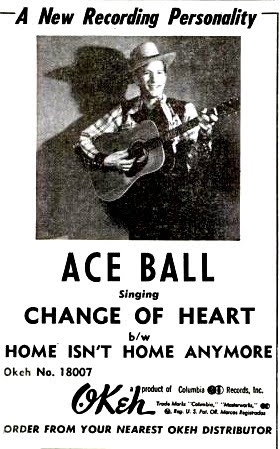
The move had to have been difficult. Balch was a big fish in a little pond in West Texas. Known professionally as Ace Ball, he was a popular disc jockey (in Levelland, Lubbock, and Big Spring) and country music performer. For almost two decades previous he was a member of Hank Harral's Palomino Cowhands, recorded for the Dallas-based Star Talent label, a solo artist on the Okeh and Caprock labels, and shared the stage with Elvis Presley and Waylon Jennings.

His elderly parents had previously moved to nearby Cañon City, and family obligations forced him to trade the West Texas arid plains for the Steel City. He took a job with local country radio station KPUB.

Billboard - October 30, 1976
While in Colorado he picked up where he left off and went back into the recording studio, producing songs on his own Ace-Hi and later Pedestal record labels. After almost 20 years at KPUB he moved across town to KIDN, where he hosted a weekly Saturday night show.

Peter Burg and Ace Ball (2003)
(photo courtesy of Peter Burg)
In 2004, after performing at a local senior center, he fell down a flight of stairs and sustained a fatal head injury. He was 84.

Ace Ball Discography:


Hank Harral and his Palomino Cowhands

Star Talent (1948-1950) 760 - Dream Band Boogie / Dilly Dally Doodle (NOTE: Please visit the excellent Lone Star Stomp blog. There you will find the story behind this recording). 764 - When They Raised The UN Flag In South Korea / You've Got A Sweetheart (I've Got Just A Friend) 773 - Red Barn Boogie / Dear


Little Oakie Darlin'
Ace Ball
Okeh (1953-1954) 18007 – Change of Heart / Home Isn’t Home Anymore 18019 – Homeless Heart / There’ll Be a New Day 18040 – Weeds of Hate / She’s Worth a Million to Me 18047 – One Armed Love / Lost


Ace Ball
Caprock (1959) 110 – I’ve Lost Again / High School Wedding Ring (NOTE: Please visit the invaluable Rockin' Country Style site to hear a sample of this song)


Ace Ball
Ace-Hi Records (1968-?)< 5464- I Cried at Your Wedding/Girls, Girls, Girls 215 - Homeward on a Hijacked Plane / For Old Times Sake 216 – Pretty is as Pretty Does / Country Boy at College 217 – The Last Rodeo / Little Red Sportscar 218 – I’ll Never Forget / Daddy’s Weakness – Cecilia Sisneros


Ace Ball
Pedestal Records (1978-1979) 1381 - Carolers Carolers / The King's Birthday (featuring Little Roy Wiggins) 1615 - Just a Little Time / A Big Hearted ET (Ernest Tubb) 1524 - You Can’t Take The Past Away / Blue Ribbon Girl 2160 - The Role Of a Step Son / There'll be a New Day Tomorrow (featuring Little Roy Wiggins)


Ace Ball
JB (1983) LP BJR101 - Ace Colorado Country - Ace Ball Sings Gene Bloomfield and Some of His Own

Ace Ball
Hornet (1984-1985?) HR 1016 - "Overnight Sensation"/"Thank You Darlin"

Sunday, August 15, 2010

Lou Amella

Interview with Karen Amella and Chuck Spurlock conducted January 2010.

It didn't take Lou Amella too long to realize that he wasn't cut out for a blue collar job.

He worked at the Pueblo Army Depot a few years, but he kept going back to what he loved to do beyond the 40 hours a week grind - making music.

"I took saxophone lessons from Lou in 1944, I was six years old," said Pueblo polka king, Chuck Spurlock. "I did that for about two years, then switched to the accordion--found out I could make more money with it."

"He played the accordion very well, as well as the piano, guitar, and the violin," said Karen Amella, Lou's niece. "I remember when I took violin in school he used to help me with it and he also helped me with the clarinet. For as long as I can remember he was musically inclined."

Born in 1916, Lou was also an avid inventor - always looking for the latest unique creation that no home could do without.

"Uncle Louie made pizza sauce with a guy named Pete Powers at a warehouse down by the Vail Hotel. He also invented the Tricky Twirl, which was a small 15-inch round plastic loop on a chain with a handle that you twirled like a lasso."

Karen was enlisted to make an advertisement for the toy, which was sold locally.

"We also did a commercial for some stilts that he invented," she said. "He also invented some type of ravioli machine, but before he applied for a patent he got drunk and broke it with a sledge hammer. Then he used to make hand lotion in the basement of the house. He did a lot of odd jobs."

In the late 1960s, Lou headed to California, to try his hand at the music industry. While there he recorded several records, including the Cecil B. DeMille, Charlton Heston-inspired "The Lord's Message."

The b-side, "Broadway up in Heaven," revolves around a dream Amella had where famous deceased historical and entertainment (Glenn Miller, Will Rogers, Buddy Holly, Johnny Horton, Hank Williams, George Gershwin, and Al Jolson) figures come together for a single performance.

"I dreamt there was a Broadway up in heaven. A world premiere was lighted by the stars, and everyone who made their home in heaven drove up a star-lit path in golden cars..."

Listen to "Broadway up in Heaven"

Released in 1970, on his own Forta Records, Amella sold the disc throughout Pueblo. It's believed that during his stay in California, he pressed possibly one other single.

"I was a little girl then, but I think he released another record--I'm not sure what happened to that one," said Karen Amella. "There was also one he recorded with a female singer, I think her name was Maria." (NOTE: Possibly referring to Rosa Lopez)

Amella died January 14, 1990.

COMING NEXT POST: Ace Ball - The Pueblo Years

Sunday, August 1, 2010

Norbie Larsen

Interview with Paul “Norbie” Larsen conducted June 2010.


Paul Norbert ("Norbie") Larsen was born and raised in the mining town of Cripple Creek. The year of his birth, in 1936, miners had extracted over half a billion dollars in gold from the nearby Cresson Mines (now known as the Cripple Creek and Victor Gold Mine).

"Dad was a miner, and I worked in the mines when I was in high school," Larsen said. "It was pretty wild back then, but we didn’t think anything was out of the ordinary - miners would get drunk and fight every night. They used to throw silver dollars, and kids would be out there collecting them."

While in high school Larsen would dabble in music, playing with friends, and serenading the cattle on his grandparents' homestead. "It was just something to do, before I joined the Navy."

While serving, he continued to sing, and looked forward to returning home to Cripple Creek, which he eventually did in 1961.

"I got married, had kids, and hit the road playing."

Larsen went on to appear on the last season on Red Foley’s Ozark Jubilee weekly television show. He also added professional rodeo star to his resume. As a Brahma bull and bareback rider, he became a member of the Professional Rodeo Cowboys Association.

In 1962 he saw a help wanted advertisement in the Colorado Springs Gazette. The ad was for The Grand Ole Opry show. Seeing an opportunity to be heard by a national audience, he took his guitar and applied in person.

"The job was actually for a telephone salesman."

Refusing to be denied a chance to play, he told the interviewer that he came with his guitar and wanted to show them his talents.

"He told me to play him a tune - and I got hired on the spot to play at the Colorado Springs stop of the Opry's traveling show."

After the gig, Larsen was invited to stay on, performing with the likes of Loretta Lynn, Marty Robbins, and Sonny James.

Returning home, Larsen booked time at KCMS (later KIIQ) radio, outside of Colorado Springs, to record his first single - a record he envisioned while serving in the Navy.

"I wanted to sing about what I knew - and what I knew about was Cripple Creek," he said.

Listen to "The Legend of Cripple Creek"


Larsen said he recorded a number of singles (unfortunately details were unavailable) throughout his music career, and even dabbled in the movie business.

"I knew this woman, who was a friend of a friend, and they were hiring folks to be in this moving filming in Cañon City," he said.

The movie was Cat Ballou, staring Lee Marvin and Jane Fonda.

Scenes were being filmed at Buckskin Joe's Frontier Town, and Larsen fit the bill as an extra.

"I'm the guy who is milking the cow, and I also appear in some street scenes - I didn't have any lines."

In the early 1980s Larsen was elected mayor of Cripple Creek.

In 1983 Larsen released I'd Rather Be in Colorado, a nine song LP, produced by Jay Angelo (formerly of The Impacs and Lobo). The album was released on the Florida-based Aanco record label.

After spending the next 20 years performing the nightclub circuit, he moved to Cañon City where he works at a nearby rock quarry.

In 2003, he released the CD Colorado Cowboy, also on the Aanco label.

COMING NEXT POST: Lou Amella