Saturday, October 15, 2011

When the hungries hit, hit the Red Barn


Interview with Bob Fredregill conducted August 2011.

In the mid 1960s brothers Jim and Bob Fredregill were looking for a franchise opportunity.

"Both of us had worked in restaurants," Bob Fredregill said. "Our company, that was started in 1962, managed restaurants for absentee owners. Most of the those were in the mountains, like the Red Lion Inn in Vail, but we also had management contracts in Denver."

Originally from Sterling, the two set their sights on Pueblo, where they would open the city's first Red Barn restaurant.

"Red Barn was a franchise establishment started by a group of men from Ohio. We thought it was very innovative, and we were excited by the concept. They had an expanded menu, with not only hamburgers, but also chicken and fish."

On Nov. 1, 1966 the first Red Barn was opened at 215 E. Abriendo. The following year a second location started serving customers in the Belmont Shopping Center, on Bonforte.

The chain was an instant success, with hungry diners lining up for the diverse menu options, including Big Barney or Barnbuster burgers, $.99 fried chicken, and fish sandwiches.


The Red Barn capitalized on their diverse menu (and its instant appeal to children) with three mascots, Hamburger Hungry (complete with hamburger head), Fried Chicken Hungry (a chicken leg) and Big Fish Hungry (a blue fish).

"We actually had our own Hamburger Hungry costume," said Fredregill. "We would enter the State Fair parade driving a golf cart, with someone dressed in the costume. It was a fun attention-getter, but very hot to wear in the summer months."

Before Burger King patrons ever learned the lyrics to "Hold the pickles, hold the lettuce," The Red Barn had their own catchy jingle, "When the hungries hit / When the hungries hit / Hit the Red Barn."

By 1974 the brothers opened their third location, in the Sunset Shopping Center on South Prairie.

Like many other family food chains, the Red Barn offered premiums to its customers. In the early stages of the restaurant, plastic hand puppets, yo-yos, comic books, plastic cups, and kites were popular with children.

Enlisting the help of local marketer, Jack Holden, the Pueblo chain branched out with its own promotional give-aways.


In 1969 the Pueblo Red Barn franchise release a red flexi disc, entitled "Sounds of The American West."

The 33 1/3 single, complete with life on the range sound effects, was narrated by a folksy storyteller who managed to sneak in a few mentions of the restaurant's signature food items.

(Dinner bell sound effects) "You know there weren't any Red Barn restaurants handy like there are now, so we had to chop our own wood, and mother had to cook over an unpredictable wood stove. But it tasted all pretty darn good, all the same. What I wouldn't have given for a delicious Big Barney."

Fredregill doesn't recollect the specifics of how the promotional record came about, who recorded it, or how many were made.


The paper cover of the flexi was covered with scenes of the west, from noted Southern Colorado photographer, John Suhay. In 2010 Suhay was honored by The Sangre de Cristo Arts and Conference Center as photographer emeritus.

It wouldn't be the last time the restaurant offered a record.

"Remember the old jingle for Coke ["I'd Like to Teach The World to Sing"]? Well, we got a whole bunch of those records and gave those out as a premium, with a sandwich and coke. But Coke found about it, and said we couldn't do it."

By the 1970s, glassware replaced records as the more popular premium offerings to customers.

"One of the biggest promotions we had was our patriotic glasses we had in 1976. Those were very popular."

By the late 1970s, the Red Barn company changed hands, and sold to Servomation, who later sold it to Motel 6. The new owners ceased advertising for the chain and the franchise leases were allowed to expire with the last of the leases expiring around 1986. At its peak, Red Barn had 400 restaurants in 19 states.

"We closed the one in the Sunset Shopping Center a couple of years after we opened it - it just wasn't a good location. We broke our franchise in 1979, and renamed the two we had left J.R Poteet's, after a character in James Michener's Centennial [trail boss R.J. Poteet]. We ran it that way for two years. We kept the same concept, and made a few changes. Then in 1981 Paul Jones and Sam Sharp, who owned Loaf and Jug, bought the business."

While the Red Barn is no more, there are numerous remnants of the restaurant. Most of the distinctive Red Barn buildings were converted for other uses. While the Belmont location is gone, the Abriendo building is now a Mexi-Deli.


By 1972 the brothers started a catering business in town. In 1974 Jim and Bob Fredregill purchased an old church at the corner of Michigan and Routt, in the Mesa Junction area of Pueblo, a few blocks from Central High School. The property would be used for office and kitchen space for their expanding businesses.

After refurbishing the structure, the Fredregills opened the upscale La Renaissance Restaurant in 1978. This year marks their 33rd year in business.

"We came to Pueblo to start the business. It’s a great town, a good place to raise a family, and we just stayed."

COMING NEXT POST: Chan Romero - The Pueblo Connection

Saturday, October 1, 2011

Pueblo Nightlife (1974)


When I moved to Pueblo in 1978, my parents liked to eat at a place called the Burl Tree Lounge, off of Bonforte and Constitution, near our Belmont home. At 17, it was my first taste of nightlife. I felt like I had been elevated to "adult status," seeing an honest-to-goodness bar, with real alcohol (not that 3.2 stuff I used to sneak with my East High friends).

The Burl Tree Lounge is long gone (now a sports bar), but to this day, I can still remember that dingy, dark, smoke-filled joint, those burgers and fries they used to sell, and the cocktail waitresses with the Aqua Net-plastered hairdos who always called me "honey."

When I was a freshman at USC, my college friends and I would always shake off the Steel City zip code, and head up to The Springs for a night at O'Furry's, Muffins, or Thunder and Buttons (I'm sure there were more, but I've lost a few brain cells since then).

Point is, I never had the opportunity to go "bar hopping" in Pueblo.

The invaluable Ange Rotondo (The Teardrops and Guys and Doll) sent me a brochure in the mail that was so good, I had to dedicate a blog entry to it.

Nite Life was a little ten page, black and white, pamphlet loaded with places to go "after hours" in Pueblo. The March 1974 issue (Vol. II, Issue VIII) is filled with a time capsule of clubbing options in the Steel City.

So to recreate the Pueblo lounge scene atmosphere of the era, dig out the polyester, put John Denver's "Sunshine on my Shoulders" (the #1 song in March 1974) on the turntable, turn down the lights, light up a cigarette, throw back a whiskey sour, and check out the advertisements below.

Enjoy!

(click on each to enlarge)


COMING NEXT POST: "When the hungries hit, hit the Red Barn."

Thursday, September 15, 2011

Silver Eagle Band

Interview with Dennis Perrino conducted August 2011.

Dennis Perrino and Bob Villalon had known each other in and around the Walsenberg and Gardner area of Colorado for years. Then one day, the two musicians decided to join forces.

"This was 1986, when we decided to form a group," said Perrino. "We recruited drummer Jerry Minogue, Bruce Mahan on bass, and Rick Witcowich (Teardrops and Guys and Doll) on keyboards, and I was the lead singer and played guitar, while Bob was on lead guitar."

They named themselves the Silver Eagle Band.

"The name of the band came about, because one day we were looking at Jerry's drums, and they kinda looked like a silver eagle, all spread out (laughs).

The band played most country covers, and a few originals, and once they perfected their act, they started booking gigs.

"We traveled all over the United States for about six to seven years, in Wyoming, Nevada, and New Mexico, plus our regular gigs in and around southern Colorado."

In 1988, the group decided to record a single.

"Robby Hudson was a neighbor of mine. He was a musician, who inspired me to play the guitar," Perrino said. "When I was 13, he was killed in a car accident, and I sang a song he had written, "Colorado Pines and Flowers." When it came time, several years later, to record our first single, I wanted it to be that song."

Listen to "Colorado Pines and Flowers"

"The single was recorded at some studio in Colorado Springs. Rick Mouser (sp) did the recording. I think we had about 3000 pressed. We would sell them at our shows."

The flipside shows a harder edge of the band.

"Yeah, I’ve been accused of being both rock and country," he said.

Listen to "Bourbon Street"

Shortly after the release, the band was selected to compete in the regional Marlboro Country Music Contest. Later they competed in the Colorado True Value Country Music Showdown Finals at the Colorado State Fair.

While the band was riding high, opening for Mark Chesnutt, Chris LeDoux, Brooks & Dunn, and Marty Stuart, tragedy would strike when Jerry Minogue died. Then Bruce Mahan left the group.

"This left a hole in the band, and we really had trouble finding a replacement - we just kinda lost our interest in the group," he said.

By 1995 the band broke-up.

"About that time Bob and I went to Nashville," Perrino said. "But after less than a year there, we wanted to come home. "

When they returned they decided to try one more time to put the Silver Eagle Band back together.

"We picked up drummer Greg Carbjal and guitarist Jim Neveil. Bob moved over to bass."

More personnel changes would occur when Jim Neveil left in 1997. Gerald Trujillo took over at lead guitar for the band. They also started incorporating more rock music in their act.

Then keyboardist Rick Witcowich passed away, in 2001.

The band returned to the studio in 2004 to record The Colorado Sky which was released as a CD.

Just when they thought they had a stable line-up, they were dealt another devastating blow with the death of guitarist Gerald Trujillo in November of 2006.

After Jerry Minogue died, the group went through a series of drummers, including John Marrella, Greg Carbjal, and Steve Vigil. Eric Valdez subs on guitar.

Dennis and Bob have remained the glue which has held together the Silver Eagle Band. In 2011 the group celebrates its 25th anniversary.

"We stay very busy, playing The Grove, The Dog Bar, and Shorty's. We're actually booked through September."

"This is the first and only band I've ever been in," said Perrino. "Bands come and go, but after everything we've been through, we're still plugging along."

Dennis Perrino on iTunes.

COMING NEXT POST: Pueblo Nightlife (1974)

Thursday, September 1, 2011

Ring ring goes the bell...


As school starts up around the region, I thought I would pull out this little 10" red vinyl find from Crowley County High School, Ordway (1963).


Crowley County High School Band - Al Smith, Director
Golden Gate
Concert Overture


Side Two: Crowley County High School Mixed Chorus - Al Smith, Director
Song of the Pedlar
O Lady Fair
To Thee We Sing - Crowley High School Small Choir
The Willow Song
The Last Words of David

The disc was produced by the prolific Century Custom label, which would go on to issue hundreds of similar recordings for local high schools and colleges throughout the country. The Crowley High record was one of the first Colorado efforts by the label, having earlier produced Western State College of Colorado: Twenty-Eighth Annual Gunnison Music Camp (1961).

In 1965 the label produced El Testamento - Spanish Folk Music of Northern New Mexico and Southern Colorado (Century Custom Records 22376), and later Duermete Nino (Custom 39908) for Alex J. Chávez (see the story here).

Ordway sits about an hour due east of Pueblo. Once a major sugar beet processing center, it's now home to the Arkansas Valley Correctional Facility. The prison opened in 1986 and houses 1,007 medium custody inmates.

Crowley County High School, Ordway, CO.

COMING NEXT POST:
The Silver Eagle Band

Monday, August 15, 2011

On Top of Pikes Peak - Billy Briggs


This coming weekend marks the running of the Pikes Peak Ascent and Marathon, and for that reason I'm going to break my rule to only feature records south of Highway 50.

As a flatlander runner, who usually crosses the finish line of a half marathon in just barely under three hours, I am in awe of anyone who can put one foot in front of the other and scale up one and a half vertical miles in oxygen-deprived surroundings.

Is the feat crazy? Probably. I nonetheless applaud the physical and mental fortitude it takes to do it. Since I could never run a half marathon fast enough to qualify for the Ascent (believe me, I've tried), I will always live vicariously through those who do.

Last September, while visiting family back home in Pueblo, I drove up to Manitou Springs. I parked the car and stood across from Memorial Park, which marks the starting point of the annual race.

Walking up Manitou Avenue, I decided to see how far I could go along the race route. By the time I got to Ruxton Avenue, not even a mile away, I wanted to collapse.

Back in the car, and just a few miles from the town, I spotted a thrift store. While digging for additions to the blog, I found this record. After my ill-attempt at following in the footsteps of those more physically capable, the title made me smile.


Listen to "On Top of Pikes Peak"
(Imperial 8239 - 1954)

Billy Briggs (1919-1984) began his musical career in 1937, as a bass and steel guitar player with The Sons of the West, and The Hi-Flyers, both western swing groups based out of the Texas Panhandle region. By 1947 he fronted his own group, Billy Briggs and his XIT Boys.

"On Top of Pikes Peak" was one of his last recordings, before he left the music industry.

COMING NEXT POST: Ring ring goes the bell.

Monday, August 1, 2011

Larry Steele

Interview with Rod Steele and Kim Steele conducted July 2011.

For as long as anyone in Larry Steele's family could remember, he was a performer - a destiny that was carved out at an early age.

"He won a Star Search contest in the 5th grade, in Longmont," said his brother Rod. "He actually taught himself how to play the guitar, and then there was no stopping him."

Born in Englewood in 1937, to Lester and Ruth Steele, music was a way to entertain the family in their Castle Rock home, where Larry was the oldest of seven boys.

"Mom had a beautiful voice," Rod Steele said.

After Larry graduated from Castle Rock High School, he got married, then moved to New Mexico, to work with a then-unknown singer, Glen Campbell.

"Glen was from Albuquerque, and so he started playing with him. Then he got drafted."

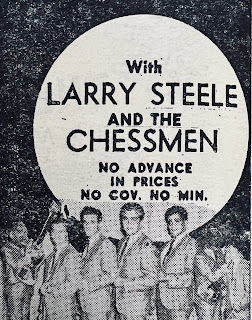
After serving in the U.S. Navy for four years, Steele picked up where he left off and came back to Colorado, where he started jamming in bi-racial rhythm and blues bands, including Larry Steele and the Chessmen.


(1964 Denver Post advertisement)

"Then one day John Capps from K-ARK records in Nashville shows up at one of his shows, and asks if he wanted to do a demo," Rod Steele said.

Steele was writing his own r&b-tinged songs at the time, so he pitched several to the label, who decided to groom him as its next superstar.

Released on the K-ARK Discoteque label (106), his first recording was an EP of six songs.


Side One:"My Lucky Day" "Last Night" "Foolish Pride"
Side Two: "Up The Lazy River""Stormy Weather" "Birth of the Blues"
(listen to samples)

Throughout the late 1960s Steele would go on to release several singles. In a risky move, he then decided to switch to country music.

K-ARK proceeded to get the word out about their new country music discovery, with the release of an LP, and a series of articles in many magazines, including Billboard.


Going to Kansas City
K-ARK 600

"Larry Steele, a Cherokee Indian, from Colorado Springs, and a pop artist, switched to country on his newest cut in Nashville last week for K-ARK, called "I'm Not Crying Mister." -Billboard, September 18, 1965

A week later, the trade magazine ran a picture of Steele.

Billboard - September, 25 1965

Steele would release several singles on the label:
K-ARK 648 – "Baby Workout" / "My Lucky Day"
K-ARK 659 – "Ramblin’ Man" / "I Ain’t Crying Mister"

"I Ain't Crying Mister" peaked at #43 on the Billboard Hot Country singles chart on January 22, 1966.

K-ARK 802 – "Hard Times" / "Apple or a Pair"
K-ARK 837 – "Hello Satan" / "Tall, Down on my Knees"


K-ARK 875 – Larry Steele and the Wranglers – "How About it Young Lady" / "Three Men on a Mountain" K-ARK 893 – Larry Steele and the Wranglers – "Yesteryear’s Man" / "Plain Simple Life"

Sometime in 1966 Steele aligned himself with the Hilltop label, the Pickwick country project. According to the April 2, 1966 issue of Billboard, Larry Steele, along with Johnny Paycheck, and Lloyd Green were all signed with the company. The story mentioned an album project, but it appears Steele only released three singles with the label: "Why Don’t They Want Me" / "Little Jimmy" (Hilltop 3011), "Little Brenda" / "Daylight Losing Time" (3012), and "Little Folks" / "Little Jimmy" (3014).

Photo courtesy of Kim Steele

"He had always been kinda hillbilly," said Rod Steele. "It didn’t matter what he played, he just played it - he just loved music. Larry was ahead of his time. When he went into country, people were just starting to hear that rhythm that you hear now in country. But interestingly enough, he really didn't consider himself a country singer."

In 1969 Rod Steele joined his bother, when Larry Steele was asked to perform in Vietnam. "I played drums for him. We did that for about three months, playing for the troops."

After his contract with K-ARK expired, he came back home to Fountain, where he decided to stay put in Southern Colorado.

"He had nine kids at this time, and I think he wanted to find something more stable," said Rod Steele. "He was playing at the Caravan Club in Pueblo, and Bob Sloan, who was the owner, told him that he wanted to get out of the nightclub business. He asked Larry if he wanted to buy the club. So he did."

Larry Steele didn't have any experience running a nightclub, but he and his wife ran the bar from 1971-1974. "He really didn't make any money out of it, and with nine kids to feed, he needed to find something else to do."

In 1972 he caught a big break by opening for Buck Owens at Red Rocks. He also signed with the Johnny Seeley record label, Airstream, based out of Fountain.

Billboard - Nov. 10, 1973

Steele would go on to release "Things Money Won't Do" / "Goody, Goody, People" (Airstream 101), and "Little Wine, Little Gin" / "Hold On" (Airstream 003), which received a favorable write-up in the June 8, 1974 issue of Billboard, as a "recommended" country song.

Seeley's intense promotion of Steele resulted in numerous write-ups on the artist. That same year, as part of a full page feature on Colorado record labels, Billboard highlighted Airstream, and its star client, Steele.

"Seeley had been in the music business for about 20 years, working clubs, bookings and the like, when he decided to form his own label. He knew Steele's talent, and he plunged ahead in the mountainous area 10 miles south of Colorado Springs. The initial recordings were done at the Buck Owens Studios in Bakersfield, and all of the backup musicians are the Buckaroos." -- Billboard - July 27, 1974

On Dec. 7, 1974, his third single "Daylight Losing Time" (Airstream 004) hit the Billboard Hot Country Charts, peaking at #90. The single stayed on the charts for five weeks.

"Watermelon Man" (note spelling of composer's first name)
Side B of "Daylight Losing Time" - the Herbie Hancock-penned

In 1975 tragedy would strike when Larry Steele was involved in a motorcycle collision with a truck. "The doctors told us that he would never walk again - but he proved them wrong," said his daughter, Kim.

Larry Steele continued to race stock cars, and take part in rodeo competitions, and he never gave up on his music.

"My dad was always playing his guitar and writing on a tablet," Kim Steele said. "We were always dancing and singing, and the record player was always going."

In 1977 he packed up his family and moved to Tennessee, where he secured a position writing songs for Acuff-Rose Publishing.

"You had to live within a 30 mile radius of Nashville to work for them," said Kim Steele. "We all moved, but that's when mom and dad went through their divorce."

Larry Steele would later remarry, and move to Alba, Missouri, in 1998. His knees had always given him some trouble, as a result of the motorcycle accident, but it never kept him from performing - until a show in Florida, opening for Mark Wills.

"He was doing this concert, and the pain was too much. He had already said he couldn't do anymore operations, so gangrene set in, and he lost his leg," said Rod Steele.

The next few months are a blur for the family. Nobody saw any signs of depression, or suicidal thoughts. Larry Steele continued to write music, and keep up with his family.

"I got the call that my dad shot himself," said Kim Steele. "I got in the car and drove straight from Colorado to Missouri. "I was able to get there before he died."

Larry Steele passed away March 6, 2003. He was 65 years old.

"I still don't know why he did it. There was just something inside of him. I don't know," said Rod Steele. "I think it took a toll on him."

Larry Steele (year unknown)
Photo courtesy of Kim Steele

"The night he shot himself, on the back of his will, he was writing a song," said Kim Steele.

"You know, Larry really didn’t want to be a star, but he could have been one," said Rod Steele. "He chose not to, nobody knows why."

Larry Steele is buried in Greenlawn Cemetery, in Berthoud.

COMING NEXT POST: On top of Pikes Peak

Friday, July 15, 2011

The Teardrops


The Teardrops
Left side of column: Ron Myers, Ange Rotondo.
Right side of column: Ernie Watta, Rick Witcowich

Interview with Angelo Rotondo conducted May 2011. Interview with Patti Jo Martinez Boyce conducted July 2011.

NOTE: In 2016, I authored a story on The Teardrops in The PULP, with additional information.


In 1964, teen bands were plentiful in Pueblo. Almost every school-age kid with a drum kit, or a guitar could be found trying to emulate their favorite bands, perfecting their sound in the family garage, or in the basement.

Ange Rotondo had just graduated from Pueblo Catholic High. Playing the drums since 7th grade, he and his South High School keyboard-playing buddy Rick Witcowich had a little three-piece outfit (with lead guitarist, Ed Elitch).

“Tom Anderson started managing us – that’s when we tried Ernie out,” he said.

Ernie Watta was a Centennial High grad, who Rick and Ange thought would make a better addition to their new band.

“He knew how to really pick a lead, so we had to fire Ed.”

It was Ernie who gave the band its name – after a bit of editing.

“Ernie thought we should be called The Rockin’ Teardrops, but we didn’t really like that, so we took the Rockin’ off.”

During a talent show to promote the Colorado State Fair, the boys discovered Ron Myers, who was set to perform as a solo singer and guitarist.

“We liked him, and asked if he could play bass,” Rotondo said. “So instead of having two acts, Ron just joined us as our bass player.”

The Teardrops had a regular gig at Jerry’s, and were in constant demand at teen dances near town.

“We used to do all of the 50s and 60s stuff – anything that came out, we would play,” he said. “Tom got us the warm up slot for a lot of shows, like Dick Clark’s Caravan of Stars. We got to meet lots of people, including Shirley Ellis, the Coasters, the Larks, and Sam the Sham.

One time we were supposed to be the warm act for Sam the Sham and the Pharaohs, when they played the Colorado Springs Auditorium, but they were stuck in Denver. Problem was, instead of everybody leaving when they heard they weren’t coming, everybody stayed. So we went ahead and did the whole three hours ourselves."

Later the “Wooly Bully” band returned the favor, and played at a Teardrops teen dance at the Armory.

As word spread about Ange and the boys, they quickly discovered the perils associated with adoring fans.

Ange Rotondo

“We just got new suits up the in Springs, these gold lame jackets and tuxedo pants, with these Beatle boots. We were doing a show with all of these screaming girls, and Tom said ‘Don’t go out in the audience,’ but we were thinking these are fans, they won’t do anything, so we went out – and got mauled.”

But that was all about to change.

“Ron knew this girl singer, named Patti Jo Martinez. They went to school together at East High. He thought she would make a good addition to the band. Our manager thought it was a good idea."

"Ron and I grew up together since grade school," said the now Patti Jo Martinez Boyce. "He played for me several times when I sang for school assemblies, as my back up. I never heard of the Teardrops until he asked me to audition for them. I thought it sounded like fun."

Patti Jo and the Teardrops
Pictured: Ron Myers, Rick Witcowich, Patti Jo Martinez,
Ernie Watta, and Ange Rotondo

While Patti Jo passed the audition, the female followers of the band weren't too happy with the addition to the group.

"Our female fans didn’t like having a girl in the group," said Rotondo. "And all of a sudden we started having male followers.”

"(Laughs) I never thought of that," Martinez Boyce said. "I was never allowed to mingle with the boys during breaks - ever. In fact, I used to sit in a room during the breaks, and one of the Teardrops would stay in there with me - they were very protective of me, like brothers."

Seizing on the cross-gender fan base, Tom Anderson decided to book some studio time in Denver for the newly billed Patti Jo and the Teardrops.


“Tony Spicola was taking an interest in managing her, and making her the next big thing,” he said. “He was also managing The Trolls, at the time.”

Listen to "Whispering Your Love"

Released on the Kurt Goletz Crazy Town label (which had previously released singles from The Sting Reys), “Whispering Your Love” prominently features the band’s new female lead, while the flip is an instrumental take on “Sixteen Tons” (Crazy Town 103)

Listen to "Sixteen Tons"

By the end of the recording session, Tony Spicola had other plans for Patti Jo as a solo act. She would go on to record “I’ll Sleep Tonight” / “Headin’ for a Heartbreak,” at Ray Ruff’s studios in Amarillo. However, after serious consideration, she walked away from performing to marry, and raise a family. She resides in Florida.

(Photo courtesy of George Krieger)

"I have awesome memories during my two and-a-half years with the group," Martinez Boyce said. "I never dreamed that I would be blessed to experience traveling, having a fan club, playing the state fair, and singing with the cutest boy band in the world (in Colorado)."

But that wouldn’t be the only shake-up in the group.

“Ron called one day and said we had to fire our manager, Tom. Ron was dating a gal at the bank, and she told him that there was no money in our band’s account, so we confronted him, and fired him. We decided to go it alone.”

One of the first things they did was go into the recording studio.

“Ron just got on the phone and called Norman Petty, in Clovis,” he said. We booked time, I think it was about $75 an hour, and recorded our singles."

Traveling down to Clovis, the band recorded the Ron Myers penned “Sweet Sweet Sadie,” and the flip, the Ernie Watta composed, “You Go Your Way.”

Listen to "Sweet Sweet Sadie"

Listen to "You Go Your Way"

"The second time we went up there, we weren’t as prepared. We recorded “Armful of Teddy Bear” (credited to Ernie Watta), and Norman said ‘You guys have a hit on both sides.' Apparently we didn’t know that you shouldn’t have two good songs on a single."

Listen to "Armful of Teddy Bear"

The b-side was “Who are You,” performed (and co-written) by Rotondo.


“I think they had me sing that song because they wanted it to stink,” he said.

The singles were released on the band’s own 004 label.

“James Bond was really big at the time, so we played off the 007, with the four guys in the band – 004.”

At the end of the sessions, Ron Myers left the group, got married, and was replaced by Mike Elias, on bass.

Pictured: Ange Rotondo, Rick Witcowich,
Ernie Watta, and Mike Elias

“The 'Sadie' picture sleeve was shot in front East High School,” Rotondo said. “For 'Teddy Bear' we went to the state fair grounds. Ron arranged for some local knockout girls to pose with us.

(Image taken from original color photo)

Pictured: Ernie Watta, Mike Elias,
Rick Witcowich, and Ange Rotondo

Rotondo admits that “probably 1500 were produced of each record.” The discs were sold at local stores.

“Back then, grocery stores were selling them.”

Armed with records, and a huge fan base, the band would receive some untimely news - Rick Witcowich was drafted into the U.S. Army.

“He said 'Just keep the band going whatever you do.' So we tried to carry on without him.”

“When Rick got back from the military, we picked up a bass player and a lead, and we called ourselves the Teardrops again, and it just didn’t work. People remembered us, but we didn’t sound like the Teardrops, so after that we dropped the name, and that was that.”

The band officially broke up in 1970.

Rotondo went on to form Guys and Doll with Witcowich. He has since retired after a long career with CF&I Steel.

"You know, if I could do it again, I would not. It was lot of work and I have the memories no one can take away. I am really enjoying retirement."

Rick Witcowich passed away in 2001.

"Mike Elias died of brain cancer,” Rotondo said.

Ernie Watta would later join the band Crushed Velvet with Scott Thomas (later of Starr). He is also credited on his wife Maxine’s hit single “Real Love” (1983). He passed away in California.

Rotondo has not spoken to Ron Myers, and is unsure of his whereabouts.

COMING NEXT POST: Larry Steele