Tuesday, May 1, 2012

Evangelist Elma and the Children of Truth


Side One:
Get Ready
Fill My Cup
I Can't Help But Serve the Lord
O Happy Day
Sweet Sweet Spirit

Side Two:
Swing Down Sweet Chariot
God is So Real
Sermonette
Get Ready

I'm a sucker for gospel albums. While I haven't been a church-goer in decades, I nonetheless understand the heart and soul that goes into these records. That, and the fact that they're the most overlooked, and plentiful pieces of vinyl at most thrift stores will make the genre one I probably post more than occasionally on here.

The local gospel LPs I usually find are fairly generic, with Osmond-looking families, posed in matching clothes, and a matriarch in a gravity-defying beehive. As I almost always bring my portable turntable when I hunt for vinyl, it becomes apparent rather quickly that most of these albums will have sanitized songs, and really nothing worthy to write about.


Elma Howze began her preaching career in 1950. The first House of Prayer started in her living room in Colorado Springs, in 1974. It soon moved to 203 E. Bijou (the current location of the YMCA, and across the street from the First Presbyterian Church), and later located to 324 N. Wahsatch.

God Is So Real was pressed on the prolific Colorado Springs-based John Law Enterprises record label (4105N10--no year), which was known for releasing numerous local Christian recordings throughout the 1970s. Since the songs were recorded at the church, the production is pretty dismal, and obviously best experienced live.

Michael Harp is the stand out performer, as the lead tenor in the Children of Truth. He's backed by Denise Waldon, lead soprano; Eddie Philon, barritone; Deborah Vaughn, 1st alto; Metta Huff, 2nd alto, and Demitta Clausell, 2nd soprano. Musicians include Fred Huff, drummer (and album producer); Beverly Harp, piano; David Vaughn, lead guitar, and Paul Jackson, bass.

Elma Howze left Colorado Springs in 2001 to form the House of Prayer in Mcintosh, Alabama.

Mozart Festival 1972


 Johann Friedrich Reichart - Te Deum
Mozart Festival 1972
PSO 8125 (no label name)
Pueblo, Colorado
Side One:
Overture and "Te Deum Landamus"
Terzetto: "Te ergo quaesummus"
"Salvum Fac Populum Tuum"

Side Two:
"Dignare Domine"
In te Domine speravi"
March from The Magic Flute
Chorale and Fuge

Performed on January 23, 1972, Memorial Hall, Pueblo.

Listen to a sample of "Te ergo quaesumus"
 
Lori Von Gundy - soprano
Charlene Vecchio - mezzo soprano
Kathie Marcum - alto
John Pinner - tenor
Jerry Matthew - bass

Gerhard Track and Sid Rosen - conductors

The festival, which was started in Pueblo in 1971 by former Pueblo Symphony director Gerhard Track, returned the following year with a performance of "Te Deum," by Johann Friedrich Reichart (1752-1814).

The concert featured a 300 voice choir, made up of high school students from Crowley (Ordway), Fountain, Lamar, Las Animas, Lake County (Leadville), La Junta and Rye.  The Pueblo Youth Symphony accompanied the performance.

Sunday, April 15, 2012

Trikk/Trick

Trikk (1988)
Clockwise from top: Patrick Smith, Donte' Smith,
Al Martinez, Mark Martinez

Al Martinez interview conducted March 2012.

In 1988 Al Martinez’s life changed forever when he received a phone call from a radio station deejay in Pueblo.

“Magic FM disc jockey JJ Valentine played a record we made, and he said the phones lit up,” he said.

That record was actually a cassette demo of “Tonight You’re Mine,” a song he and childhood friend Patrick Smith put together with Patrick’s brother Donte', and Al’s brother, Mark. The group sent out the demos to local stations in hopes of getting airplay.

Calling themselves Trick (Patrick’s nickname), the Colorado Springs-based group, which formed just a year earlier, quickly released “Tonight You’re Mine” as a 12” single (Upward Thrust - Trick01 - 1987). The disc was recorded at Startsong Studios, in The Springs, and produced Rich Mouser.


“We shot the cover of the single out at Prospect Lake. The original picture had us standing on the ice in the middle of the lake, but the shot really didn’t work. So we used my 1976 Corvette.”


“Tonight Your Mine” caught the attention of the Aanco record label (which in 1983 released Norbie Larsen’s I’d Rather Be in Colorado). The record brass liked the sound, but not the spelling of the band’s name – changing it to TRIKK.


Side One:
Tears
I Can't Wait Forever
Tonight You're Mine
Do You Like It

Side Two:
Never Say Never
Midnight Lover
I Can't Get Used to This Feeling
Still Waiting

Al Martinez, along with Rich Mouser, produced the group's first LP, Never Say Never (Aanco 28802-1988), and quickly released it to a national audience. After getting favorable attention from Radio and Records magazine, the album would generate three singles from the mellower cuts on the record, "Never Say Never," "Tears," and “Tonight You're Mine," and one of the dance tracks, "Midnight Lover."

“Tears” would go on to be #1 on Magic FM’s countdown,” he said.

The band caught the attention of Bertie Higgins (“Key Largo” fame), who wanted to record the song “I Can’t Get Used to This Feeling.”

“Our record company tried to put that deal together, then Bertie wanted us to sign the publishing rights over to him. I told Aanco, that if Bertie records a demo, and if it’s better than mine, then he could have it. He didn’t take the deal.”

In 1991, A&M records called a meeting with the group in Denver.

“They told us we were very marketable, and that our sound was good, but they were moving more toward alternative music, more grunge. They asked if we could go that route with our music. We tried that sound, but it just didn’t work. They ended up going with the Gin Blossoms and Blind Melon.”

"That same year we went to Seattle and recorded what was to be our next release, This Time."

The LP spawned two singles, “I Love Italian Girls,” and the title cut.

“Both got airplay in Iowa,” Martinez said.

After six years together, the band decided to take a break. Patrick headed to law school; Al got married and opened his own studio. The hiatus would last four years, when, in 1998, Trikk reunited with Eddie Adkins on guitar, and Dave Copeland on bass. The group would soon welcome Dave’s brother, Lyndon.

“About the time we went into the studio to record The Final Battle, I started concentrating on songwriting, engineering and production,” said Martinez. “The band felt that Lyndon brought a vocal style to the group that would elevate us up one more notch—which it did.”

“The album can be best described as kind of a 80s retro sound – stuff that influenced us when we were kids. We put out samplers around the Colorado Springs area, and felt really good about the project.”

But friction among the members started to unravel the group, and the final CD was never released.

“The real issue the group was having, was a divided loyalty over which songs would be on the album. I think Dave felt pressure to side with his brother, Lyndon. Hence you have a lost of interest, and that’s when Lyndon and I began to work on solo projects. I then had an opportunity to get to Los Angeles, and I took it, and that was pretty much it.”

Of the original members, Al Martinez went on to open his own studio (Innovative Studios), where he continues to record his own music. Patrick Smith is a lawyer in Portland. Mark Martinez has his own landscaping company in Colorado, and Donte' is an executive for Popeye’s Chicken.

Last year the band received a resurgence of interest, thanks to – Justin Bieber.

“His fans would Google his hit “Never Say Never” and our song would come up. Of course, they aren’t one in the same.”

Sunday, April 1, 2012

Dave Jackson


Jerry Dolby and Clara Reida interviewed March 2012.

On my most recent trip back home to southern Colorado, Pueblo-based record dealer, and dear friend, Joel Scherzer presented me with an album for my collection – one that would turn out to be probably my favorite find of the weeklong record search.

Dave Jackson Singing Folk Style Music - Morning Town Ride (Valerie VR 7000) is a collection of 16 songs of the genre. "Many of the songs selected are personal favorites, but there has been no attempt to display any of my own views or personal feelings," he writes on the back cover.

Included are Jackson's renditions of songs penned by Donovan ("Colours"), Tom Paxton ("I Wonder Where I'm Bound"), Rod McKuen ("Two-Ten, Six Eighteen"), Pete Seeger ("Turn Turn Turn"), as well as several traditional folk numbers.

The LP isn’t produced well. In fact, I dare say there is any production whatsoever to this album. It almost sounds like the recording was made in a closet. But the sad, loner vocals, and the barely audible guitar easily makes the record memorable.


I had to find out who Dave Jackson was. But there were few clues to go on. The album appeared to be a product of the Custer County Independent School District, based out of Westcliffe. The school’s science teacher, Jerry Dolby, is listed as the school sponsor of the recording.


“I did find the 1969 yearbook for Custer County High,” Dolby said. “The picture of Dave Jackson is the same as the one for a sixth grade teacher of the same name. I can find no evidence of his being on the faculty for more than one year.”

According to Dolby, the annual also shows a “Mrs. Dave Jackson” on the faculty, who was the pep club sponsor.

“I'm confident the class sold Dave's album as a fund raiser for a class trip.”

The cover art was done by Margaret Locarnini.

“Margaret was quite an artist, she was a super talented person,” said Clara Reida, who also worked at the school, and later bought a ranch with her, to raise horses. I remember there was a big brewhaha in the area, and she had to leave her job at Custer County, to go teach in Florence. Apparently the valley was being developed and a billboard was cut down, and how it was pinned it on Margaret I don’t know. But she had to leave her job.”

Attempts to locate Dave Jackson were unsuccessful.

Monday, March 12, 2012

Daddy Ed's Original Children's Stories (Band Box)

A recent eBay purchase of some Colorado records put me in contact with a most generous seller, who loaded me up with some great state vinyl. In the box was a 7" 78rpm red vinyl children's recording, Daddy Ed's Original "Sammy the Skunk" / "Dummy the Duck," on Band Box. The record did not carry the familiar Band Box logo, and in all of the history I read on the label, there had been no mention of a children's recording.


The story of Band Box goes that, in 1957, Romanian immigrant Aurelia Vicky Morosan (1909-2006) saw a newspaper ad for a studio for sale - Columbine Records. She bought the company, and called it Band Box (after Columbia Records pitched a fit about the similarity of the names). The label churned out about 200 singles (and a few LPs) in the late 1950s through the 1960s, including from Orlie & the Saints, Lee Chandler & the Blue Rhythms, Jimmy DeKnight, and Freddie & the Hitch-Hikers.

With that knowledge in hand, I set out to find whether or not this Daddy Ed record was, in fact, on the same Band Box label as the one Vicky Morosan owned.

This is where the history gets fuzzy.

A search through Billboard magazine's 1957 archives found an advertisement for a studio for sale, in Lakewood Colorado. Viola! Could this have been the ad Vicky Morosan saw when she bought Band Box?


Wait up... this ad (dated 1957) says a label called Band Box, not Columbine, was for sale. The year is right, according to the archivists, but not the name.

The ad mentions that the buyer will receive, among the other holdings, Daddy Ed's Original Children's Stories. So I was able to confirm what I had was a Band Box record, but were there two Band Box labels in Denver?

The actual record information on this Band Box label is pretty sparse, minus a very lengthy patent number. After spending several hours on the phone with the U.S. Patent Office, in Washington D.C., I found that the number, "671-182-617-863," doesn't relate to anything in its files. Swell.

Next stop was my Complete Guide to Vintage Children's Records Identification and Price Guide (Peter Muldavin 2007). Nada. Not one single reference to any Band Box children's recording.

"I have never heard of it before," Muldavin told me, when I contacted him. "It's probably a local record issue, perhaps by a local radio or TV children's show personality. There were literally hundreds of these types of shows in the late 40's through the 60's. Many made their own records."

So I set out to find the contact person in the advertsement - "A.V. Pasca" in Lakewood. But calls to every single Pasca residence in Colorado resulted in another dead end.

I'm not one to give up, so I did some more searching. On a hunch (and some additional digging) I was able to find that Karl Zomar owned the Denver-based Columbine record label at least until 1954. There was no record of him owning it after 1954.


Lo and behold, after some additional phone calls to the U.S. Patent and Trademark Office in Washington, D.C., I found out that the name "Band Box Records" was registered in 1954, by, guess who? Aurelia Vicky Morosan - three years earlier than all of the history on the label had proclaimed.

So if Vicky bought Columbine from Karl Zomar, in 1954, and had the dust-up with Columbia over the name, and then changed it to Band Box, the Daddy Ed record would have to be dated sometime after 1954.
Furthermore, the familiar Band Box logo was officially trademarked in January, 1962, at least according to the patent documents.

So if Vicky owned Band Box in 1954, who is "A.V. Pasca," and what's with the 1957 advertisement posting a Band Box label for sale in Billboard? I have to admit, that one had me too, until it dawned on me - could the "A.V." stand for Aurelia Vicky?

Yup.

When Vicky's parents, Elena and Demeter migrated from Romania, in 1913, their last name was Pasca (the family later changed the spelling to Paskie).

In 1957, after apparently owning the label for three years, she decided to sell it. Hence the ad in Billboard. Thankfully she didn't have any takers, and groups such as Orlie and the Saints, Bill Goodwin, the Four Chevelles, Warren Robbe, and numerous others were able to put their songs on vinyl for all the world to hear.

In 1971 she tried to sell the label again.


Which left me just one piece of the puzzle to find. Who is Daddy Ed, the narrator of the two stories on the record?

For that answer I enlisted the help of 1950s era Denver disc jockeys, who seemed to think that it's Ed Scott, who was doing Denver radio around this time, before he moved over to television, and interestingly enough, starred in a long-running children's program as "Sheriff Scotty" on KLZ-TV (later KMGH-TV).

Unfortunately, it's not Ed Scott.

"I did record records at Band Box, but I'm not Daddy Ed," he told me. "I did record four songs there at the Band Box studios, but they were for the Moppet children's label. I recorded them with a trio of guys, including Art Gallo (sp?). We recorded "The Rocking Horse Rodeo," "Wonderful Land of New," "Wonderful Land of New, Part Two," and "If You Never Make An Enemy You Never Lose a Friend."

Oh well.

Thursday, December 15, 2011

'Tis the Season for SoCo Gospel

Every December I like to feature something of the non-secular nature, to get into the spirit of the holiday season. In this post I found two quite nice, but obscure Southern Colorado recordings that I'm hoping someone can shed a bit more light on.

First up is The Valley Singers, out of Capulin--birthplace of Alex J. Chávez, and near Manassa, home to Dot and Jimmy Vaughn.

Side One:
He is the Way
Con Que Pudiera Yo Pagarte
Stumbling Stone
Ya No Es Tiempo De Jugar
I Never Want to Forget
Ya Ven Senor

Side Two:
Brother, Won't You Help Me
Maniana
The Mame of my Friend
Jesucristo
Lord Help Me Love
Ten Misericordia

The album (Alta Vista 8890/1976) is apparently the second from the group, who are made up of Emily, John, Linda, Gene, Elva, and Nick. No last name is shown on the disc. The notes on the back indicate that they are all from the same family.

LP is a nice blend of English and Spanish language folk gospel. Lots of guitar.

Recorded at Alta Vista Studios in Albuquerque, that's pretty much it on this one. Again, any information would be helpful.


The next find is from Joyce Griesel, a sweet folky femme vocalist, who appears to be out of Salida (back notes from Pastor Keith Frederickson at the 1st Baptist Church there, and who apparently passed away in 2008). LP was recorded at Summit Studios in Denver, and pressed by the prolific folks at Rite in Ohio (33372-1974).

Side One:
I Looked for Love
Put Your Hand in the Hand
Holy, Holy
Victory in Jesus
It's Love
He's Got The Whole World in his Hands
Like a Lamb

Side Two:
He Touched Me
Happiness Is
The Old Rugged Cross
For God So Love the World
In The Garden
Turn Your Eyes Upon Jesus
Heaven Came Down and Glory Filled My Soul
Give Me Oil in My Lamp

"I have been singing since I was seven years old, and began voice lessons at the age of 15. I have wanted to record from the age of 13, but never figured it would be possible. Then in April 1974, we were in Albuquerque where we met and listened to the Kings Quartet. After visiting with these gentlemen and their giving me the name of their recording company in Denver, the ball began to roll."

Appears she is accompanied by "Smokey Len" Kapushion.


Unfortunately she passed away in October. I located her ex-husband's family, who told me that Joyce had hoped the recording would help establish herself as a professional singer. After her divorce she moved to Aurora, remarried, and became a computer technician. This was her only recording.

Thursday, December 1, 2011

The Trolls - Monty Baker

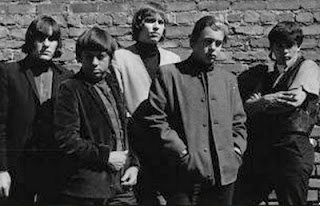
The Trolls (left to right, Fred Brescher, Richard Gonzales,
Doug Rymerson, Phil Head, and Monty Baker)

Monty Baker interviewed August-November 2011

Monty Baker’s contribution to the Southern Colorado music scene is legendary. As a member of the Trolls, The New World Blues Dictionary, and Jade, it’s often assumed that he was a native of the region.

The fact is, he’s a product of the Hawkeye State.

“I went to high school in Iowa, and went to college in Minnesota – that’s where I got together with the band I was in, The Radiants,” he said.

The Radiants were made up of Richard Northrop (formerly of The Night Crawlers) on drums, Doug Rymerson on lead guitar, Ryan Carter on rhythm guitar, and Monty Baker on bass. Monty, Doug, and Richard were attending Mankato State College at the time, while Ryan was attending the Glamour Beauty Academy in Minneapolis.
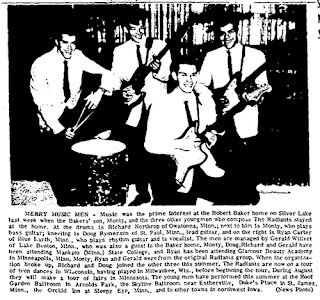
(Click on picture to enlarge)

July 9, 1964 issue of the Lake Park News:

Monty Baker and the other members of The Radiants and their manager are guests the remainder of the week at the home of his parents, Mr. and Mrs. Bob Baker. The Radiants played during a three-hour broadcast over KSUM radio in Fairmont, Minn., Monday evening. The group played during intermissions at the Roy Orbison show at the Roof Garden in Arnolds Park Tuesday evening. The musical group will perform at the teen dance at the Skyline Ballroom near Estherville Sunday night. The men are now living in Owatonna, Minn.

April 1, 1965 issue of the Lake Park News:

Monty Baker visited Sunday with his parents Sheriff and Mrs. Bob Baker. Monty, a member of The Radiants band had a just completed a five-week engagement in Cedar Rapids, and was en route to Ispedmina, Michigan, for an engagement at The Roosevelt Hotel. The Radiants will return to Iowa City to appear at The Hawk, April 22, 23 and 24.

The Radiants, who were all under 21, worked around their age limitations at 6-percent clubs-- thanks in part to fake IDs.

“I was Denny Blake, and I guess I had that fake ID until I turned 21. When I turned 21 and got a license under my real name, Monty Baker, and they wouldn’t accept it,” he said. "So I used my fake ID to get some real beer."

While touring the United States, The Radiants ended up playing a gig in Pueblo, and got to know The Trolls.

“After the gig, we went back home…and then Uncle Sam and the draft broke up The Radiants,” he said.

“So Doug Rymerson and I called up Phil Head of The Trolls and asked him if he wanted a lead guitar and bass player. So we went to Pueblo. I guess this was 1965.”
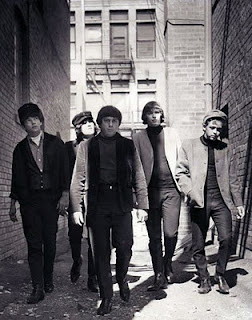
The Trolls (left to right: Monty Baker, Fred Brescher,
Richard Gonzales, Doug Rymerson, and Phil Head)

“We all were known by our nicknames. Lead vocalist and guitarist Richard Gonzales was ‘Speedy,’ keyboardist Fred Brescher was ‘Brush,' and drummer Phil Head was ‘Flip.’ I was ‘Denny,’ and lead guitarist Doug Rymerson was ‘Digger’."

The band portrayed themselves as having a harder edge than most local bands, at the time - playing covers of Kinks and Stones songs.

“We had members of our fan club in California get us their newly-released records, before anybody ever heard of these songs in Pueblo.”

The Trolls were regulars at The Columbine, and Jerry's, where they were the house band.

“We were working all of the time, doing weekends and special gigs. We were working five hours a night, most nights. We’d make $400-$500 in one weekend.”

Baker says several of their live shows were taped.

"I think I have eight reels somewhere, with about ten shows on them.”

In the early stages of the reformed Trolls, Baker took the lead as the group’s manager.

“We never signed a contract. When we said we would do a job, we did. We gave our word, and we were there. I remember a particular gig we were playing at East High School. They wanted a contract and with much prodding from the members, I signed it, because it was good money. Our normal thing was play 50 minutes, with a 10-minute break. So we played the 50 minutes and took our break, and this teacher comes up and she’s irate as hell because she said we had to play four hours without a break—it was in the contract. She got the principal and I explained that if he screwed with me, and the band, I was going to tell the kids why we were packing up and leaving, and he would have a riot on his hands. The principal tore up the contract, and we got our check, before the next set.”

Then Southern Colorado promoter Tony Spicola stepped in, and took the band under his wing as its manager.

“I remember we won a recording session in a Battle of the Bands contest, that was held at a Pueblo movie theatre. I think there were about 15 or 20 bands competing. We kind of rigged it. We had a bunch of our fans in the audience, and they started screaming like were the Beatles, or something. So when it came to vote, we won.”

“We ended up meeting this guy named Ray Ruff, who had a studio in Amarillo. We went down there to record our first single. I thought Iowa was flat. I remember getting into an argument with Digger about whether or not the road was sloping, or not, on the drive down. To prove the point, we peed in the middle of the road. It didn't move."

The band’s first single included two Fred Brescher compositions "That's The Way My Love Is" / "Into My Arms.”


Listen to "That's The Way My Love Is"

“I think we recorded, oh what, maybe a dozen more songs, but they are all lost – from the fire.”

In 1968 the Ruff studios burned to the ground. Countless masters, from numerous recordings, were lost.

“The Ruff sessions were different, as compared to the first time Digger and I were in the studio with the Radiants. We made a record for the SOMA label – in fact, we were in the studio the same time The Trashmen were recording “Surfin’ Bird” (In December, 1964 The Radiants released "Special Girl" / "Ain't Got No Home"). The Ruff recordings were difficult because the Trolls played “on” each other live—we played as a band. We kind of fed off each other and Ray Ruff had us recording each of our parts separately. So the drummer did his thing, the guitarist did his thing, I did my thing – it was actually pretty traumatic.”

A few months after the Ruff sessions, the band traveled to Clovis, New Mexico, to record at the Norman Petty Studios.

"I think this would have been 1965 or early 1966. I really don't remember much about that recording session."

The studio time resulted in one single, the Speedy Gonzales-penned "I Don't Recall," and a cover of the Mick Jagger/Keith Richards composition, "Stupid Girl."


Listen to "I Don't Recall"

The single was released on Chan Romero's start-up label, Warrior. The band posed for the picture sleeve photo in a Pueblo park - minus one member.
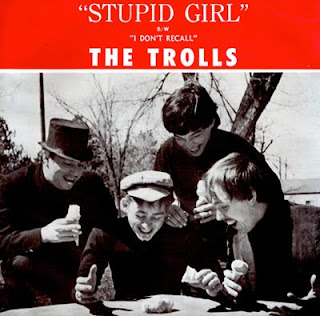

The Trolls, left to right: Richard "Speedy" Gonzales,
Phil "Flip" Head, Monty "Denny" Baker, and Doug "Digger" Rymerson

“Freddie wasn’t in the picture. Two nights before we took that shot, he touched his amp with one hand, while he played the organ with the other, resulting in a violent jerk of his arms, collapsing his lungs, and he ended up in the hospital."

"Our manager, Tony Spicola took that picture. He wanted us eating ice cream. When he took the shot, Phil’s ice cream came out of his cone.”

Baker estimates only 500 copies were pressed.

The flip side of the jacket features art from Baker's then-wife, Leryln (she signed "LKB" on the far right sleeve).
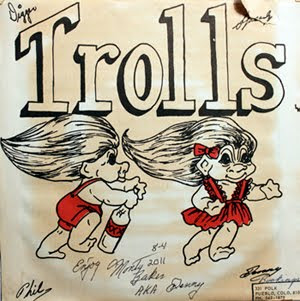

“We made it and they played it on the local radio station in Pueblo, and if we had a prom or a show out of town, we would take some to the local station where we were playing – of course we had to put some money under the table so they would play it.”

The band split up in 1966, shortly after the release of the record. Baker didn't want to elaborate on the reason why.

“Things just fell apart, and we just went our own way. I joined up with The New World Blues Dictionary.”

The Colorado Springs-based NWBD originated as The Persuaders, in 1964. The band was made up of Dave Julian on guitar, Lynn Larson on bass, Bob Crowder on keyboards, Jim Boitos on saxophone and Denny Townsend on drums.

After going through a number of name changes (including Filthy Five, and Goguenard) they settled on their new name, and a new lineup, with Baker replacing Larson on bass. Cabell Shepard replaced Bob Crowder.

“We played primarily psych rock, and was booked quite a bit at the Honeybucket in town.”

In July 1967 the band opened for Jefferson Airplane at The Broadmoor Hotel.

“I can tell you quite a bit about that show. The Airplane’s crew drove over the mountains, and lost one of their trailers with the light show in it. We were the opening act, and the local union was running lights for us. It was nothing fancy, just your standard lights with different colors."

"So Grace Slick comes out and berated the light guys, and embarrassed everyone with her tirade. Our manager went up to the light guys and got them to mix the lights, and when we came out of the second break, we had these great colors. When Airplane came out, they just had this one white light on Grace, and she was pissed."

"The local newspaper came out to cover the show, and said that we blew Airplane off the stage.”

It wouldn’t be the only time the band would share the stage with future hall of famers, opening for Eric Clapton and Cream, and Chuck Berry.

“We were asked to join Chuck Berry on a five day tour. So we get there at 1:00, expecting to practice with him. He shows up five minutes before the show, and I go ballistic. When I got done, he looked at me and said, 'Do you know how to play that thing?' I answered 'You bet your ass.' So he said, 'Let's go impress these people.' The guy is a total pro. We get up on stage to join him and we’re trading licks back and forth like we had been playing together for 20 years. He offered to pay us $2,000 a week to come on his one month tour of Germany, and he would pay all expenses. Jim and Dave refused to go because they were college guys."

"The night we did the show with Clapton we got done playing and Dave and Jim came up and said, ‘We’re done,’ so we broke up that night."

NWBD disbanded in 1968. Baker would go on to join the Pueblo band Jade, with Cabell Shepard, Marty Spritzer (who had been in The Chandells), and Murray Watson on drums.

“I think at one time we actually had two drummers in the band.”

Jade lasted about two years, resulting in one single “That Was Yesterday” / “I’m Leaving You.”

“The band wanted to get me replaced, so they kept playing with other bass players, but what they didn’t know was that I owned 90% of the equipment. By that time my marriage was going south, and we went our separate ways, and I went on a vacation by myself. I decided to go back to Iowa and get a real job, using my other occupation, as a respiratory therapist. So I said the hell with it, and became a respiratory therapist."

Baker is now semi-retired from the health care industry, and continues to live in Iowa.

COMING NEXT POST: 'Tis the Season for SoCo Gospel