Tuesday, October 13, 2026

Yet Another Band Box 336 - Murlee Hart

Hey all! So I was chatting with Eric at the last Rocky Mountain Record Show, who offers me a couple of Band Box studio recordings, credited to Murlee Hart. The first thing I notice is that they show "Band Box #336," which corresponds with Ronnie Kae's 1964 release "Swinging Drums" / "A Flight For Drums." 

I'm only guessing the folks at Band Box had an overstock of Ronnie's labels and reused them for test pressings and acetates, for other artists. You will find that label number on "Kit Polka / Eastlake Waltz" and "Mountain Flower Waltz" / "Too Fat Polka," by the Alpine Polka Dots (acetates) and Marion Price's test pressings, "O Holy Night" and "Musetta's Waltz." 

Back to Murlee Hart...

Born in 1921, in St. Louis, Margaret Murlee Hart came to Denver in 1940, where she earned her master’s degree in education at the University of Denver then a doctorate from the University of Colorado. She became one of the first African-American teachers at a Denver public school. According to her 2015 obituary she also a prolific songwriter, penning more than 500 songs. 

According to the Catalog of Copyright Entries, a few of her songs included "Baby I'm in Love" (1948), "Eastersong" (1948), "I Walked Down by the River" (1949),  "When It Gets Dark the Stars Come Out" (1949) "Velvet Fog" (1949), "Do You Remember" (1953), "How True Are You" (1953), "Song of Christmas" (1953), "Get Thee From Me" (1956), "You're Just in Time" (1956 with Harriet Salter Rice), "What a Drag" (1957), "Dark Blue" (1957).

Unfortunately, it appears only two of her songs were ever recorded. "How True Are You" / "Tried But Not True" feature an uncredited country-sounding male singer and a sticker across the original Ronnie Kae label. As always gang, if you have a clue on who is vocalizing her compositions, let me know.


Monday, September 14, 2026

Discover Colorado in 1952 (radio jingles)


Hey all. Here are a couple of "Discover Colorado '52" radio jingles, hyping tourism in the Rocky Mountain State. Appears to be a Colorado State University production, along with the Rocky Mountain Radio Council. No clue who the female singer is on these.


"Discover Colorado in '52" (First version - :17)


"Discover Colorado in '52" (second version - :15) 

 In 1952, the Rocky Mountain Radio Council was actively writing and producing regional programming, including "You and the Law" for the Colorado Bar Association that year. Following the Federal Communications Commission (FCC) decision to set aside channels for non-profit education, the Rocky Mountain Radio Council met with Denver Public Schools and the University of Denver to plan a grassroots educational television station, which launched KRMA-TV (Channel 6)—the station known today as Rocky Mountain PBS. The radio council essentially dissolved as its members shifted their energy and assets into pioneering public television.

Sunday, September 6, 2026

Presenting the 1949 Pontiac

This next piece is not Colorado, per say, minus the very cool KCSJ Pueblo radio record label. The acetate transcription disc contains a series of commercials for the new 1949 Pontiac. Instead of local personalities, the disc features nationally-known radio newscasters of the day (sorry for the audio quality).


Earl Godwin was dubbed the "Earl of Godwin" by President Franklin D. Roosevelt and he was often referred to as the "Dean of Broadcasters." Godwin would end his broadcasts with the phrase, "God bless you, one and all." He has a star on the Hollywood Walk of Fame.


Walter Kaner broadcast using the name "Tokyo Mose" during and after World War II. After the war, he served as a stand-in host on the Ed Sullivan show. 


Don Goddard worked as a newscaster for New York radio stations WMCA  and WINS. He later worked as a commentator for the early NBC News television documentary-style show, "Watch the World."  A newscaster for ABC News, he was one of their primary announcers to break the news of the assassination of John F. Kennedy in November 1963. 


Also included on the disc are newscasters Andre Baruch (later Brooklyn Dodgers announcer) and Ben Grauer (former silent film actor, then newscaster, who later announced New Year's celebrations in Times Square for NBC, from 1939-1979).

The disc doesn't mention any local dealership, but it's assumed they were used for The Colorado Motor Car Company (which originally set up its operations in Pueblo in 1912) which held the town's primary franchise rights for Pontiac. Right after World War II, the company transitioned its hub directly onto Santa Fe Avenue, which would remain a permanent landmark for Pueblo car shoppers. The dealership eventually evolved into the modern-day Wilcoxson GMC located at 902 North Santa Fe Avenue.

Monday, August 31, 2026

FOUND - Jimmy Dorsey Recording (Lakeside Amusement Park - 1950)

Hey all - been a very long time since I have posted. My apologies for the lack of content. Book sales are still active, but I'm now diligently working on the second edition. Thank you to all who have added it to your libraries!

Jimmy Dorsey (famous in his own right and brother of the equally-talented Tommy) appeared in Colorado on more than 50 occasions, performing multi-week residencies in and around Denver, throughout his career, before his death in June 1957.

Up until now, finding any live recordings of his Colorado concerts were believed to be nonexistent. While the shows were broadcast live, radio stations often recorded selections on fragile acetate discs, which lasted about as long as one playback, then usually tossed.  

Was recently offered a stack of Colorado 78rpm recordings and radio transcription discs (which I will soon be posting on here). In the batch was this incredible historic audio - Jimmy Dorsey performing at Lakeside Amusement Park. While the label notes a June 8, 1950 date, this could be a slip of the pen. According to Down Beat magazine, the band was booked at Lakeside from June 26 through July 8, 1950. Whatever the date, finding this upbeat bop jazz live recording (due to length, posted on YouTube) is astonishing. Crazy man, crazy solos on this disc. 

Enjoy a listen to “Muskrat Ramble,” which includes Dorsey (clarinet and alto sax), Charlie Teagarden (trumpet), Ray Bauduc (drums) and Cutty Cutshaw (trombone). The disc cuts off, but you can hear the announcer's entire locale "From the Patio Ballroom at Lakeside, you've been listing to the new sounds, the new look..." 


Sunday, April 13, 2025

Elk Bugles (the book) is Available for Order!

"Most intense, thorough book of its kind I've ever seen..." 
- Jello Biafra

Pleased to announce that the book is finally done and ready to order. Books are published on demand, direct from the publisher.  So, no refunds or returns.  460+ pages. All color photos. Close to 3,000 bands and singers, and more than 6,000 records, listed (alphabetical, by singer last name or band name). See previous blog post for more information.

Softback $69.99 / Hardback $99.95 Takes about 10-14 days from order, for delivery.

Order softback and hardback HERE.

My sincere thanks for everyone who had a part in this massive undertaking. 

I'm going on vacation, now.


Thursday, February 13, 2025

Elk Bugles - The Book (coming April, 2025)


 "The most intense, thorough book of its kind I have ever seen..."
 - Jello Biafra

 I'm very pleased to announce the upcoming publication of Elk Bugles - A Collector's Guide to the Lesser Known Shellac/Vinyl Recordings of Colorado (1900-2000).

Contained in the 450+ pages are close to 3000 band and singer entries, along with full-color photos. 

Unlike books which feature one category of music, Elk Bugles acknowledges the diverse genres which have come out of the Rocky Mountain State. Rock/pop, metal, punk, garage, soul, hip-hop/rap, Spanish-language, country, polka, lounge, square dance, spoken word...

Looking for John Denver, Judy Collins, Firefall...? Yeah, you probably aren't going to dig this, as "well-known" Colorado bands and singers are missing from these pages. If your bag is "real people," private label vanity recordings, then I think you'll find this guide your thing.

Both hardback and softback versions will be available, starting by April, 2025. Ordering links coming soon.

My apologies for not paying much attention to this blog. As you can imagine, I've been pretty much in book mode. I'm also announcing that I've decided to archive this website. It's been a fun run, for 16 years, but life only gives you so many trips around the sun. This site will continue to be accessible, until I forget to pay the domain bill (grin).


Monday, June 24, 2024

Sad News to Report - Angelio DeHerrera (The Sonics)


It's always tragic to find out about the passing of yet another person who contributed so much to the Colorado music history archives. I received word that Sonics co-founder, Angelio DeHerrera, passed away, this month. I was so fortunate to meet up with the band, almost five years ago, for an extensive interview and this blog post.

Thank you to his family for the opportunity to pick his brain about the band, and Pueblo music history.

Read more about his life, in his obituary, and in his honor, blare this song!

Wednesday, May 1, 2024

The Playboys


In 1958, two Colorado Springs musicians teamed up with four music students at the University of Colorado, Boulder. Together they were known as The Playboys. While most teens were boppin' to the sounds of Elvis and the Everly Brothers, the six young men were known for jazz.

Regulars at college dances (mostly at CSU in Fort Collins) and nightclubs, The Playboys recorded their one and only vinyl offering, Playboy Impressions. Recorded in 1959, at Bud Edmunds' KCMS studios, in Manitou Springs. 

Minus a successful bid on an eBay auction, I have never come across this record before. Guessing these had a small pressing, quite possibly only sold at their shows. The seller didn't have any connection to it. Who knows, but it's a fantastic find.

The tracks on the red-colored vinyl are pretty much jazz combo standards, minus the energetic cover of the` Billy Eckstine  / Four Freshman bopper, "Mr. B's Blues," and a take on Peggy Lee's "Fever" (samples below).


Listen to a sample of "Fever"


Listen to "Mr. B's Blues"

 Members:
Tom Forgey - Drums
Don Hake - Trumpet / Vibes
Norm Helwig - Piano
Dick Skipton - Tenor Sax
Bob Smith - Trombone
Rick Vaughn - Bass 

The cover features model Lou Ellen Morrow, a University of Colorado student, from Colorado Springs.  The Playboys would only last through the end of their college years. The last noted appearance of the band was in 1964. 

To confuse things, there were apparently other Colorado groups going by The Playboys, including 78s recorded by Smiley Macom and his Western Playboys (Frontier 502 and 503), Jimmy Lake and the Colorado Playboys (Band Box 380 - "She Awoke / Where Will it End"), Sef and his Playboys, Schroeder's Playboys, who would appear on Marvin Shilling records, The Polka Playboys, The Rocky Mountain Playboys who back Johnnie Dwyer, and a standard four-piece outfit, going by The Playboys, who would occasionally back Kenny Jay (who also appeared with the Fabulous Roadrunners).

Tom Forgey would go on to be elected Arkansas state representative. Norm Helwig would become an attorney, in Vail. Don Hake would pass away in 1998. Dick Skipton still lives in Colorado. I couldn't find any additional information on Bob Smith and Rick Vaughn. As always, let me know if you have anything to add.

Monday, April 8, 2024

Emissaries of Divine Light - Paul Levine


Found in a stash of private issue new age cassettes, at an Aurora estate sale - same place I found the previous post. While the first cassette was a hodgepodge of heavy breathing, chanting and a general mishmash of audio, this next tape might be one of my favorite Colorado finds, so far this year.

Simply titled Expressions I, this is a singer-songwriter gem. Paul Levine is just a man and his guitar. Accompanied by an uncredited female background singer (or two), it's simplicity at its finest. Sadly, there is absolutely no other identifier on this, minus a 1990 year notation. Just a tape and a picture of the Paul.

It appears Paul was associated with the Emissaries of Divine Light, as the address on the tape is to its Loveland compound. The songs all have a feel good "let's all live together in harmony"  - but not an overtly religious -  vibe. Definitely NOT a typical loner sound, associated with most SSW finds.

Yes, I DID notice that this Paul Levine has a more than passing resemblance to the author of the same name. I contacted him to ask (answer still pending). I'm going to assume they are not one in the same, but who knows.


Thursday, April 4, 2024

Emissaries of Divine Light

Emissaries of Divine Light formed in 1932, with the belief that a "human beings' true qualities can only be known as they are expressed in practical daily living." In 1945, international headquarters were established in Loveland, headed by Lloyd Arthur Meeker. The first mention of the group, in the press, was in the April 17, 1949 issue of the Rocky Mountain News. The very small brief, in the religious section of the paper, only indicated that "another service was underway, southwest of Fort Collins, by a religious group, known as the Emissaries of Divine Light."


After Meeker died in a plane crash (note above), the leadership passed to William Martin Alleyne Cecil, 7th Marquess of Exeter ("Lord Exeter"), who had been a dedicated adherent.

Almost as soon as ground broke, locals became suspect of what was soon described as a cult. Core beliefs included attunement, or "energy medicine" - "attuning of the human capacity with the universal animating spirit within all people." Members believe that universal life energy is conveyed through the hands of the practitioner, through endocrine glands.

Discovered this tape at an estate sale in Aurora. The find was included in a box with about half a dozen various new age cassettes. No additional items about the this particular tape were found. Assuming the year on this is 1987, based on the only date listed on the cuts. Titled Sounds, Words and Silences, the find starts of with several minutes of (very) heavy breathing, followed by a sermon from Lord Exeter on the topic of silence. What follows is some African chanting and ambient piano music. Side B includes a talk on love and more light piano. Then we are treated to more chanting (this time in Russian), and some jazzy improvisation on flute, synthesizer and fluegelhorn. The selection entitled "Improvisation on Roland synthesizer" sounded promising, but I guess they forgot to include it. The side ends with howling, screeching and droning chanting.

NOTE: The descriptive above is more impressive than the actual audio. I haven't decided on plans to dub any samples, at this time. Stay tuned - I will be posting audio from another Emissaries of Divine Light-related cassette found in the stash.

Side A

Glen Ivy Women's Chant Group -  Breathe
Lord Exeter - August 30, 1987 - Sunrise Ranch
Empumalanga Collage
  - Zulu singing
  - Michael Boon
  - Absalom Makathini
  - Grace Makathini (translated by her son Gideon)
  - Zulu singing
  - Michael Boon
George Hanson - Concert, Cape Town, South Africa
Andrea Milinkovich - "Lullaby for Ultann"

Side B

Ellen Roos - Thoughts on improvisation
George Johnson - Improvised study in just Pythagorean tuning
Rob Sutherland - Improvisation on Roland synthesizer
Soviet Collage
  - Change - Sunrise Choir
  - Bruce Allyn
Gary Diggins - Fluegelhorn improvisation at King View concert
Still Meadow Chant Group - Chant

Martin Cecil died on January 12, 1988. The group continues to be headquartered in Loveland, under new leadership.


Friday, March 1, 2024

Alice Forsyth and Chauncey Parsons - Colorado's First American Idols (1916)

In 1916, long before American Idol, The Voice, and the myriad of other talent competition shows, the Columbia Graphophone Company held a talent contest in Denver, to find the "two best amateur voices in Colorado." The winners would receive a trip to New York City and travel to Bridgeport, Conn., to visit Columbia "laboratories" (this was before they were called studios), to make a record. Money raised from the recording would go toward a scholarship fund for other amateur singers. 

The first mention of the contest appeared in the May 15, 1916 issue of the Rocky Mountain News.

Previously, singing contests were local events, held at fairs, churches, or even bars. Prizes were minimal. Contest winners would compete for everything from small cash prizes and ribbons, to desktop statues of Mozart. The lure of being recorded, on a nationally-known music label flooded the paper with entries. According to the Boulder Daily Camera, a total of 431 people entered the contest, sponsored by the Columbia Gramophone Company, and the Rocky Mountain News-Denver Times. Out of those entries, 12 singers would perform live. 

More than 4,000 people packed the Denver Auditorium to witness the competition. It was reported that "2,000 were turned away."  

The singers would be judged by Colorado College Music Professor Edward Danforth Hale, University of Colorado Music Professor George M. Chadwick, along with Henry Housley, L.B. Longacre, and J. Nicoll Vroom. 

Participants included Chauncey Parsons of Boulder, Mrs. William Frantz of Lafayette, Royden Massey, Alfonso Ortiz, N.S. MacDonald, Edward Hartwell, Milner Gleaves, Stella Toffler, Gertrude Livingston, Alice Forsyth, Jane Crawford, and Mary Bowles, all of Denver.


Photo from the sold out contest finals, at Denver Auditorium. Winners pictures in inset (click to enlarge).

The two winners were chosen based on a criteria of "natural voice, tone production, interpretation and diction." Of the one dozen finalists, Chauncey Parsons and Alice Forsyth would emerge as the "best voices in Colorado."

The following day, the two left for New York City, where they were greeted by reporters eager to meet the newest singing discoveries. Just three months later, Columbia would release the contest record (Columbia 60935 / 1916).

Hear sample of "Last Rose of Summer" - Alice Forsyth


Hear sample of "Mother Machree" - Chauncey Parsons

The two would embark on a brief promotional tour, for Columbia, however they would soon take different directions in their performance careers. 

Shortly after the contest, Alice Forstyth would be engaged to wed John Marsh Mosher, who was born in Greeley. She told reporters that "marriage would not affect her singing career." Her wedding was held the following year, in Greeley. Royden Massey, who was one of the original twelve contestants, sang at her ceremony. While she spent her post-contest years back in Colorado, the newly-married couple would later move to Los Angeles. Alice would perform mostly in California, and appear on KHJ radio, but she eventually decided not to pursue a career in show business. She passed away in 1991.


Photo of official contest winner recording session (click to enlarge).

Chauncey Parsons' singing career took a huge leap, after recording the disc (note: Before 1925, all 78s were recorded by the artist singing or speaking into a horn, as shown above. The voice directly vibrated the recording stylus. These were called "acoustic" recordings). After appearing on numerous stages, (including Broadway) he would be one of the first performers on the new invention - radio. Parsons would go on to have a regular show on KDKA, in Pittsburgh, the first commercial radio station to sign on, in 1920. Just two years later, he would perform at Carnegie Hall, in New York City, the first of his two appearances there While his live performances were often hailed as "spectacular" (he performed again at Carnegie Hall in 1926), his recording career never took off. In 1926 he recorded "Sunrise and You" / "One Little Dream of Love" for the Victor label. However, according to the label archives, the songs were never released. The following year he would leave KDKA and move back to New York City. In 1930, he tried one more time to make a record, "In the Gloaming," for RCA. The disc was meant to be a promotional record for Northwestern Yeast Company. Label ledgers indicate that the master recording was "personal"; it was made on commission or not intended for release. 


In 1932 he was pictured on the cover of sheet music, for the song "Here's Hoping." That same year he was featured in Radio Dial, where it mentioned his involvement with the Chicago Civic Opera, and his upcoming extensive tour of the western United States. In the 1935 issue of Radio Personalities, he is highlighted among Rudy Vallée, Fred Waring, and fellow Denverite, Paul Whiteman. That same year he moved on to WLW radio in Cincinnati, OH., where he performed as "The Singing Neighbor" for almost ten years.

As was the case with most entertainers, in the 1940s, he joined the military. In 1945 it was reported that he was a lieutenant colonel, serving in Europe. The trail goes cold, after that. If you have any additional information, please contact me. 

As for plans to replicate the singing contest, in other cities? Colorado was the first and only state to take part. Columbia never held another similar event. It's unknown how much money was raised for the intended "scholarship." 

While this is an early recording example of a Colorado artist, the first known Colorado singer to record goes to Elizabeth Spencer (shown above), who recorded an estimated 600 pieces for the Edison label, from 1910-1916. She later recorded for the Victor label, before passing away, in 1930.

Thursday, February 1, 2024

Foster's Old Time Fiddlers

Charles D. Foster was born in Nebraska, in 1880. His family later moved to Oklahoma, then (drum roll, please) Colorado. Musically proficient, Foster could play a number of instruments. It was in Colorado where he began his love of square dancing and fiddle music. Much like his famous-counterpart, Lloyd "Pappy" Shaw, Foster promoted square dance throughout the state, calling dances throughout Colorado, with his band Foster Folkway Features / C.D. Foster Orchestra. 

Aurora Democrat - Dec. 4, 1942

In 1942, Foster penned what was considered the first set of dance "cards" (square dance calls used by announcers). Learn to Dance the Foster Way were so successful, he printed a second volume. A third set would feature caller Charlie Thomas.


Click to enlarge

The test pressing records featured were discovered at a South Denver area estate sale, in a custom case. These are an amazing Colorado music find, which were destined for the trash, on the last day of the sale (whew). They were made in 1948 and notes K-W Recording, which is otherwise known as the Folkraft label (home of Grady Hester, Shorty Warren, Harold Goodfellow, and the Folkrafters). Interesting to note, the Folkraft Country Dance Orchestra featured early Pete Seeger recordings (1946).

According to a story in Let's Dance (December 1948 issue) - "Veteran square dancers have always clamored for twelve-inch unbreakable records of music without calls. The new Folkraft "Homesteader" series of four records on vinylite certainly satisfies this need. Music is by C. D. Foster's Old Time Fiddlers—and is the real "fiddlin'" music traditionally authentic to the square dance. Callers, accustomed to the orchestra-type music (all that was previously available) may find these strange to work with at first—but they are the real stuff. These records are obtainable singly, and are numbered F-1026 to F-1029. Some of the titles are intriguing. "Steamboat Bill," "Speed the Plow," "Mississippi Sawyer," "Down in the Tall Grass," etc." (NOTE: Denver's Lorraine Wingo [1926-2004], known for her accordion talents on the Western Caravan TV show, with Daughters of the Pioneers and Gene Autry, also recorded on the label, that same year - F-1023-1025). 

Listen to a sample of "Mississippi Sawyer"

Listen to a sample of "Down in the Tall Grass"

Foster's band would continue to tour throughout the 1940s, appearing as a regular at the Moose Hall in Denver, and the Golden Chateau club, in Golden. 

 Colorado Transcript - April 21, 1949 (click to enlarge)

In 1947, Foster appeared as an associate editor of American Squares magazine. He died in 1976, and is buried at Crown Hill Cemetery, Wheat Ridge.


Monday, January 1, 2024

Penny Carson Nichols Vinyl Release


What a way to start the new year!

I've kept this news quiet for almost three years (and it's been brutal). Shortly after my January 2021 post, I was contacted by Yoga Records, with interest to re-release the Penny Carson Nichols cassette. 

The result is spectacular. Only 500 of these masterpieces will be available, on vinyl. If you are a fan of Connie Converse, Sibylle Baier, Molly Drake, and Vashti Bunyan, you will love this previously-unreleased Colorado find.

Preorder yours, today. (February, 2024 vinyl release, or download today).

My thanks to Penny, for trusting us all with her work. I'm so glad your beautiful voice will now be shared with a larger audience. Thank you to Douglas McGowan, at Yoga Records, for his constant pursuit of music which needs to be heard. Thank you to Tyler Craft and Chris Cohen for your producing and mastering magic.


Thursday, December 14, 2023

Rockley Music - Lakewood, Colorado

Wanted to post this cardboard flexi from the Rockley Music Company, Lakewood. I can only guess that this was supposed to be like a radio commercial (given the :30 length), but sadly there is no year to attach to this. No ID on who the announcer is. As is the case with most older flexi discs, the sound quality is atrocious.

Rockley Music began in 1946 by Melvin and Mildred Rockley. Its Colfax location stayed in business until 2019, later moving to Wheat Ridge. The family also runs the Rockley Family Foundation.

Sorry for the long absence. Had to take about a year off from posting to work on other projects, one of which includes a soon-to-be re-release of a previously-unknown Colorado recording. Very excited to share that will you, in the next couple of months. All good.

I can't guarantee I'm back to regular posts, but I hope to keep this blog semi-active in 2024.


Thursday, December 1, 2022

Doug Rymerson (Lead Guitarist for The Trolls)

 Doug Rymerson (right) with Phil Head (photo courtesy of Phil Head)

Sad news to report that Doug Rymerson, the lead guitarist for the iconic garage rock band The Trolls (audio), has passed away.

The news came by way of Trolls drummer Phil Head, who shared this tribute:

"I learned this morning of the passing of Doug Rymerson (Digger) lead guitar for the Trolls. A more gentle spirit you could not find. I shared my first apartment with him and lived together in several places. He was the TROLL I was closest to. We were drinking buddies back in the day. Denny (RIP), Digger, and myself shared a mobile home for a short time. Digger spent endless hours meticulously learning the latest songs. His work ethic had much to do with our success. He was from St Paul, Minnesota and I spent a Christmas with him and his parents getting to meet all of his high school friends. All being gentle people help to explain his demeanor. I am so glad I got to spend part of my musical life with him. God bless you Digger, you made many people happy while you were with us."

More pictures of the group

Monday, November 7, 2022

Our Next Governor March - A.W. McIntire

Hey all! Finally getting around to filing a stack of sheet music I have, and (re)discovered this amazing find - a 1894 copy of "Our Next Governor March."

Nice early political Colorado piece, as it appears to be a composition hyping recently-elected Governor Albert Willis McIntire.

This has to be the first piece of music memorabilia mentioning the tiny San Luis Valley town of Conejos (below the governor's name).

Yes, I did noticed that the last name of the governor (and his hometown city name) is spelled wrong. I guess in the hurry to print, accidents happen. 

Composed by C.E. Anderson, the instrumental was published by Argenta Music, Denver. It lists J.J. Guentherodt as its copyright holder.

McIntire was Colorado governor from 1895-1897. According to his obituary he was originally from Pittsburgh, but relocated to Colorado in 1876.  He announced his run for governor, in 1894. In the general election, he defeated the Populist Governor David H. Waite and the Democrat Charles Thomas. During his administration, leasing of state lands was limited to ten years, the State Bureau of Mines was created, and the age of consent for girls was raised from sixteen to eighteen. In June of 1896, he sent the state militia to Leadville to put down a strike of silver miners. His term ended on January 12, 1897 and he resumed the practice of law and ranching in the San Luis Valley. He purchased a large cattle ranch on the Conejos River, north of the present day town of La Jara.

He died in 1935, and is buried in the La Jara Cemetery.


Saturday, September 10, 2022

God Save the Queen


Hey all. While the gender and royal title have recently changed, I wanted to post this rendition of "God Save the Queen," by the NORAD band. The EP features sign-off music for either radio or television (back when both would only stay on the air until midnight). Side one features "America The Beautiful" and "The Star Spangled Banner." Side two includes "O Canada," and "God Save the Queen." Songs were directed by Major Vic Molzer and produced by Capt. Terry Hemeyer (1:10 audio below).

Rest in peace, Your Majesty.

Thursday, August 4, 2022

You'll really dig the action at Tulagi's!


Working on a massive reel-to-reel project, helping a friend sell off his incredible collection. Among the finds is this undated radio commercial for Tulagi, the historic Boulder bar. Warning, this catchy jingle will be an earworm! 

Listen

I'm not going to copy and paste the hard work of others, so head over to the About Boulder website, for more on this iconic location, and its rich music history.

Wednesday, July 6, 2022

The Greatest Musical Attraction in the History of Pueblo

A small portion of this story ran in the July issue of Pueblo County Historical Society Lore magazine. For whatever reason, the piece was missing the art, and other important details. Here is the story, in its entirety.

In 1917, in an effort to promote its new “talking machine” phonograph, the Victor company put together what was considered the first “super group” of musicians. The ensemble would be called The Record Maker Troupe, and originated with well-known performers Billy Murray, Henry Burr, Albert Campbell, John Meyer, Arthur Collins, and Byron Harlan, Teddy Morse and Vess Ossman.

By 1922, a Victor Victrola cost a Pueblo music lover about $150, the equivalent to $2,500 today. For the average resident, coming out of the 1921 recession (and a devastating flood the previous year), it was a luxury many couldn’t afford. Many music stores, such as Knight-Campbell offered payment plans, as low as $3 a month (the equivalent to about $50 today). To encourage sales of record players, local Victor dealers Knight-Campbell, Silver State Music, and D.Z. Phillips Music stores convinced Victor to bring their recording stars (renamed the Eight Famous Victor Artists) to Pueblo. 

 “You can hear them any day of your Victrola, but only this once can you look upon them actually, in person, and feel the magic of their buoyant personalities” Pueblo Daily Chieftain - Jan. 19, 1922

A large newspaper ad proclaimed the event, which was held at the City Auditorium, as “The Greatest Musical Attraction in the History of Pueblo.” It would feature a literal who’s who of Victor recording artists, of the day - Henry Burr, Monroe Silver (who replaced Byron Harlan), Frank Croxton (who had replaced Arthur Collins), John Meyer, Albert Campbell, Fred Van Eps (who replaced Vess Ossman), Frank Banta (who replaced Teddy Morse), Billy Murray, the Sterling Trio, and the Peerless Quartet. “It would be the first time in history these famous Victor artists have visited Pueblo. Fill the house Monday night, and they will come again,” the Feb. 12 Chieftain proclaimed. Ticket prices ranged from $1-$2.50 ($16-$41 today). Maybe thinking that the cost was too exorbitant for locals, the paper declared, “Oh you cannot afford to miss the Victor concert on the 13th of February. It will be great and well worth anyone’s time to hear.”

Billy (“The Denver Nightingale”) Murray (1877-1954) was born in Philadelphia. His family moved to Denver in 1882. He is credited with calling attention to the music of George M. Cohan (“You’re a Grand Old Flag”). He would go on to record many other well-known songs - “Alexander’s Ragtime Band,” “Meet Me in St. Louis,” “Over There,” and “Casey Jones.” He was inducted into the Colorado Music Hall of Fame, in 2016.

Henry Burr (Harry Haley McClaskey) had first come to Denver, in 1920, and would be considered one of the first performers to use a microphone. According to Popular American Recording Pioneers, “It is reported that he used wooden bowl with an inverted telephone transmitter, during the Denver show. The broadcast could be heard all the way to San Francisco. He was also a member of the Peerless Quartet and Sterling Trio. He died in 1941.

Monroe Silver (1875-1947) was known as a comedian, whose routine used an exaggerated Yiddish dialect. His claim to fame was adapting vaudeville performer Joe Hayman’s earlier “Cohen on the Telephone” routine, into other Cohen routines - “Cohen Gets Married” (1918), “Cohen on His Honeymoon” (1918), “Cohen at the Picnic” (1919), “Cohen at the Movies” (1919), “Cohen Talks About the Ladies” (1919), “Cohen Takes His Friend to the Opera” (1921), He often performed with Billy Murray.

Fred Van Eps (1878-1960) was a celebrated banjoist, and the father of jazz guitarist George Van Eps. He was the creator (along with Henry Burr) of the Van Eps Recording Banjo. He is often credited as influencing pre-bluegrass/roots musicians, including Charlie Poole (“Don’t Let Your Deal Go Down Blues,” “White House Blues,” “If I Lose, I Don’t Care,” “Sweet Sunny South,”).

Albert Campbell (1872-1947), John Meyer (1877-1949), were members of both the Peerless Quartet and Sterling Trio, which were considered one of the most commercially successful groups of the era. The group made hundreds of recordings, including popular versions of songs such as "Sweet Adeline", "By the Light of the Silvery Moon", "Let Me Call You Sweetheart", and "I Want a Girl (Just Like the Girl That Married Dear Old Dad)". Frank Coxton (1877-1949) was also a member of the Peerless Quartet. The groups broke up in 1928.

Frank E. Banta (1897-1969) is not to be confused with his famous father, Frank P. Banta (1870-1903) was an early ragtime performer. Frank E Banta was a regular pianist with the Joseph C. Smith’s Orchestra, the Van Eps Trio and Quartet, the Club Royal Orchestra, and the Great White Way Orchestra.

Five days before the big event, it was reported that “Present seat sale indications for the Eight Famous Victor Artists show that very few, if any, seats will be available after the next few days.”

(click to enlarge)

Concert Program 

First Set:

Opening chorus - Entire Company
“Get Comfortable” (words and music by Ray Perkins)
Baritone and Bass Duets - John Meyer and Frank Coxton
“Goodbye My Love”
“Just Like a Rainbow” (recorded by The Benson Orchestra - Victor 18823)
Stories and Songs by Monroe Silver
“Irish Home, Sweet Home” (recorded with Billy Murray - Victor 18794)
“Cohen’s New Automobile”
Sterling Trio
“Tomorrow Land” (recorded by Sterling Trio - Victor 18837)
“That Old Irish Mother of Mine (recorded by Sterling Trio - Victor 18696)
Banjo Solo - Fred Van Eps
“Nalia”
Tenor Solo - Henry Burr
“Old Pal Why Don’t You Answer Me” (Recorded by Henry Burr - Victor 18708)
“I’ll Take You Home Again” (with quartet - Victor 18781 Henry Burr and Peerless Quartet)
Tenor Solos - Billy Murray
“Ten Little Fingers and Ten Little Toes” (recorded by Billy Murray and Ed Smalle - Victor 18830)
“Stand Up and Sing For Your Father an Old Time Tune.” (recorded by Billy Murray and American Quartet - Victor 18784) 

INTERMISSION 

Second Set: 

Piano Solos - Frank Banta
“Operatic Nightmare”
“Marionette”
“MonHomme” (duet with John Meyer)
Tenor Duets - Campbell and Burr
“Underneath Hawaiian Skies” (recorded by Al Campbell and Henry Burr - Victor 18730)
“Sunny Side Sal”
Stories and Songs - Monroe Silver
“Rebecca” (recorded by Billy Murray and Monroe Silver - Victor 18748)
Bass Solo - Frank Croxton
“Song to the Evening Star” (recorded by Victor Orchestra - Victor 18759)
Banjo Solo - Fred Van Eps
“Cocoanut Dance”
Peerless Quartet
“My Sunny Tennessee” (recorded by Peerless Quartet - Victor 18812)
“Somebody’s Mother”
“Medley of Foster Songs”
Tenor Solos - Billy Murray
“When Francis Dances with Me” (recorded by Ada Jones and Billy Murray - Victor 18830)
“Humpty Dumpty” (recorded by Billy Murray and Ed. Smalle - Victor 18810)
Closing Chorus - Entire Company
Frank Banta, Accompanist
“Words cannot fully describe music of the eight Victor artists, who appeared at the city auditorium Monday night, and faced a full house.” -Pueblo Daily Chieftain, Feb. 14, 1922

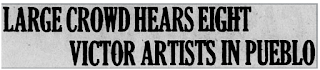
According to reviews of the show, the sold-out performance (which varied between 1,600-1,900 people in attendance) was a success for both the attendees and the entertainers. “Every number on the greatly varied program was so well received by the audience that the hearty and earnest applause brought the artists back to the footlights two or three times.” 

 “If you heard the Eight Famous Victor Artists at the Auditorium last Monday night - if you were a part of the great audience who enjoyed that wonderful program, you can perpetuate your memories with their VICTOR records.”
- Advertisement (above) Pueblo Daily Chieftain - February 15, 1922 (click to enlarge)

The troupe, in various incarnations, would spend a total of 11 years on the road, promoting Victor Victrolas and Victor label recordings. On February 26, 1925, Rudy Wiedoeft, Monroe Silver, John Meyer, Frank Croxton, Albert Campbell, Henry Burr, Frank Banta, and Billy Murray recorded “A Miniature Concert,” Victor’s first commercial electrical recording. In 1928, the group performed in the MGM film At the Club. They would disband that same year.

Tuesday, June 21, 2022

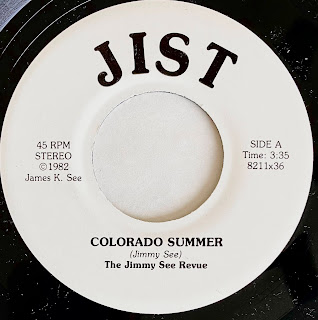
Colorado Summer - Jimmy See Revue

On this first day of summer, I thought I would feature this aptly titled song. 

I found reference to the Jimmy See Revue from January to March, 1980, in the Colorado Springs Gazette. He was a regular entertainer at Parlour Pub, on Garden of the Gods Road. After March, I couldn't find any other notice of him performing at any club in the Springs, or anywhere else.

In 1982 he recorded the single "Colorado Summer," which was released on the JIST label. 

Listen to "Colorado Summer"

The flipside of the record, "Tonight I'd Love the Rain to Fall," features an uncredited female singer, with a more-formal vocal performance, accompanied by a piano. 

According to his 2011 obituary, he was a resident of Littleton. He passed away at the age of 67.  

As always, if anyone has additional information, please contact me.