Wednesday, June 15, 2011

Solve the Mystery: Jack Shiplet and the Blue Ridge Boys

Sometimes I stumble upon a Southern Colorado record that is literally a mystery. When I've exhausted every possible means of locating any information, I'll post these finds here - in hopes that someone who reads this blog can help out. As is the case with this nice (but crunchy) country disc from Jack Shiplet and the Blue Ridge Boys (Jim Cox credited on vocal), out of Rye, Colorado.

On the Green Towers label, the single also notes a catalog number associated with KCMS radio (KCMS 1067/1068). As I have done another story about a record with the same notation (see Norbie Larsen piece), and confirmed that record was recorded at the Manitou Springs studios, let's assume that was the case here. No clue on when this was recorded.

"I Won't Make You Wait" is credited to Horace Kemble. A quick search indicates that Horace and his wife owned and operated the Green Towers Lodge in Rye. My guess is that Jack and the boys were performers there.

The record is arranged by a "C. Vroom." In my last blog post, Blaine Reininger mentioned that he took guitar lessons from a "Mrs. Vroom, who had a studio on Orman Avenue, with her own record-cutting machine." Let's go with it as being the same person, unless I hear otherwise.


The flipside, "This World is Not My Home" is an Albert Brumley-penned song, later made popular by both Hank Thompson and Jim Reeves.

COMING NEXT POST: Don Sloan

Wednesday, June 1, 2011

Blaine Reininger


Interview with Blaine Reininger conducted March 2011.

In 2016, I authored a story in The PULP on Blaine, which also includes additional information.

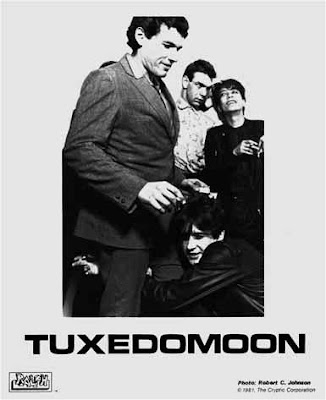
Author's note: Some 30 years ago, when I was a student disc jockey at KTSC at (then) USC, I discovered a record on the studio shelves by the group Tuxedomoon. I had what passed as an alternative ("new wave") music show back then, so I threw the disc on the turntable. "No Tears" blew me away. A quick scan of the station's limited music library revealed another from the band, "Joe Boy...The Electronic Ghost." I segued the two, and became an instant fan.


Last year I was contacted by a reader of this blog, who told me that I should contact Blaine Reininger, the talented multi-instrumentalist, and one of the founders of Tuxedomoon.

Little did I know, he was from Pueblo.

Ain't it a small world.


Where did you go to school in Pueblo?

I went to Fountain Elementary, Risley Junior High, Centennial High for a while, East High, and then SCSC.

When did you graduate?

I graduated East in 1971.
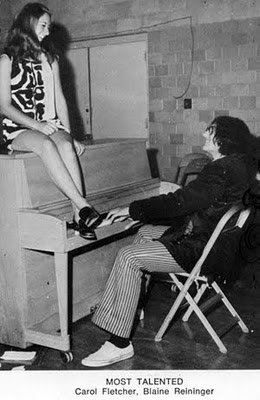
East High yearbook (1971)

You started playing music pretty young, right?

I started music at the age of six, with a singing teacher named Miss Atkinson - I don't remember her first name. We did recitals all over the place. I particularly remember a recital for the Eastern Star (the women's auxiliary of the Freemasons) for which they gave me a piece of fruit cake with whipped cream. I date that as my first professional engagement. I guess that was 1959.

I took up violin at the age of nine, first being taught at Fountain School by the bandmaster of East High, Mr. Dixon, who didn't really play violin. He went from school to school teaching. I took up guitar after I first heard The Beatles and there was no going back. My teacher was named Mrs. Vroom. She had a studio on Orman Avenue, with her own record-cutting machine, and an amazingly slobbery little bull dog you could swing around on the end of a towel gripped in his teeth.

My violin teacher, whom my family hired primarily for his cheapness, was a guy named Bert McKinnis who lived down on East 3rd Street. He had left Pueblo in the 1920s, went to a conservatory in Kansas, and was touring the country with an all-girl vaudeville orchestra, when the depression hit. He was forced to return to Pueblo, got a job at the brickyard, was hit in the shoulder by a pallet of bricks, and didn't play violin for 20 years or something. He took up violin and teaching again in 1965, and took me and another guy on as students. He had a collection of hundreds of violins. He did his own fiddle work, ate raw garlic by the clove, taught me a new word at every lesson. He told me to "hitch your wagon to a star."

He was an enormous inspiration and the grandfather I didn't really have. I wept when he died.

Tell me about the Tycoons, your first group.

The Tycoons were formed in 1965 to play at the Fountain School talent show. I was, of course, already a fixture in this show. I was in it every year from 1959 on. In 1965 I was in it three times, the most satisfying of which was with that band.

The members of the Tycoons were me on guitar, John "Kutz" Pagnotta on drums, Roger Calloway on guitar (his brother Steve was a noise in the rock scene already), and Sammy Lucero on guitar.

Encouraged by our teacher, Jerry Rosen, we all wore matching white shirts and bow-ties. We played "Watermelon Man," and an instrumental version of "Lucille." We tried to pay some girls to scream for us, but they just took our money and didn't scream. We played a church gig or two and then disbanded.
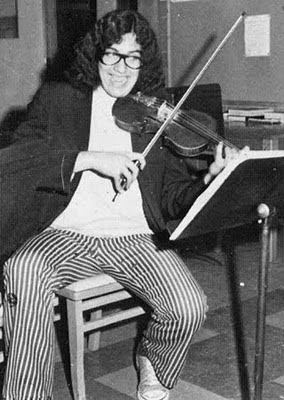
East High yearbook (1971)

I will never forget Sammy Lucero telling me, when we were all getting ready to leave Fountain School for Risley Junior High 'If you keep playing that violin when we get to Risley, you can't be in the Tycoons no more.'

I replied 'Sammy, 'I'll take my chances.'"

What music were you listening to? What was starting to influence you?

In junior and senior high, I started to listen to psychedelic bands, inspired by what I heard of the Beatles and the other stuff on KDZA radio. That radio station was amazing, you know. I was also inspired by the local music scene, bands playing in the street on flatbed trucks, releasing records played on KDZA and especially at the State Fair. I formed the first band after the Tycoons, the Sands of Time, which had some success in the junior high world. We were pretty psychedelic. We pooled our resources in order to buy a Univox fuzz pedal from Ready Music on Main Street for $12. It was mine, or course. At this time, the great divide in the local band scene began to appear, with many Latino bands calling themselves "soul" and our type "psych". There were often violent confrontations over this division.

The Sands of Time played around Pueblo, even at a strip club (none of was over 16-years old at the time). We disbanded when there was a palace coup and I was replaced as lead guitarist and singer and fuehrer.

I jammed with a guy named Gary Csogi out in Boone, who is now a prominent session drummer in Las Vegas for a while, but the first real professional outfit I joined was called Lime. The drummer Mike Green (later of Junk Yard Band, and briefly with The Crew). asked me to join. The other guys, Don Debay and Ed Chapman were 20-years old, so I thought I had landed with a bunch of men. I played bass with them, having decided that I was only an adequate guitarist, but a killer bassist. We toured around Colorado, booked by some agency in Denver. I really thought I was hot stuff.

After the inevitable break-up of Lime, I kept the name Lime alive with a series of bands, playing with members of The 25th Hour, in particular the brilliant and funny Gary Fowler (Kemikol).

The next band of significance was called Wheat which was an unplugged outfit. We had no drummer and we played a sort of country rock reflecting the sort of thing being done in the early 70's. We also wrote some really good original stuff, a kind of proto Tuxedomoon, if you will. Two of our members, Brian Ritchie and Donovan McNeilly are still fixtures of sorts on the Pueblo arts and music scene.

After Wheat, I played for a short time with Ron Ellis and his brother, becoming the third Ellis Brother. We played some Holiday Inn-type gigs and that was that.

My next band was called Flying Whale out of Manitou Springs. We continued to tour around Colorado, playing ski places. Then I got fed up and split for San Francisco, with the idea of forming a multi-media postmodern electronic outfit. That is what I did. Tuxedomoon was born.

So you get a music degree, and then bail for the West Coast - why did you decide to leave Colorado?

I decided to leave Colorado because I thought that the music scene was pretty much confined to playing in bars and playing covers forever and ever. I wanted to go further. I see that some interesting groups like 16 Horsepower have come out of Colorado now, but the prospects of advancement from Colorado back then were pretty dismal.

Why San Francisco?

San Francisco was the first big city I had seen, apart from Denver, and I was awestruck.

Do you still keep up with folks in Colorado? Any family still there?

My brother lives in Denver. He is a drummer in the local scene, and still plays in Pueblo. His children and their children are mostly in Denver. His eldest son, Drew already displays the musical gene which blesses and curses us. The vast hordes of my mother's family are mostly in Salida.

In 1984 you, along with Mikel Rouse of Tirez Tirez, recorded Colorado Suite - a four-track, 28-minute mini-LP. I guess you know where I'm going - was this composition inspired by your time in your home state?

My song "Windy Outside" was written from the gnawing, almost pathological homesickness for the United States that I began to feel after a few years in Brussels.

I didn't manage to get back to the United States at all between 1982 and 1999. I just couldn't raise the money. When I did get back in 1999, and since, I felt as foreign as any other immigrant, in my own country.

I was able to appreciate Pueblo's otherworldly beauty in a new way, though. This was a good and healing reconciliation, since Pueblo's brujo charms, the arroyos, the desolate windswept majesty of Mineral Palace and City Parks, Lake Clara, the State Fairgrounds, the Fountain River and the Arkansas, were seen with new eyes. I experienced a kind of ecstasy to return and explore Pueblo on my bicycle.

The rest of my story is to be found on my website.
http://www.mundoblaineo.org/
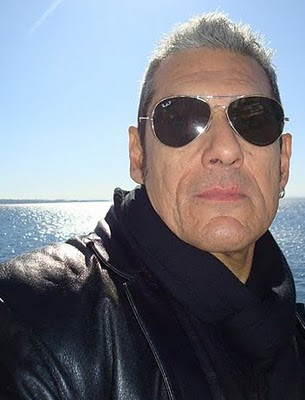
Blaine Reininger (2010)

COMING NEXT POST: Solve The Mystery - Jack Shipley and the Blue Ridge Boys

Sunday, May 15, 2011

Chuck Spurlock - The Pueblo Polka King

Chuck Spurlock interviewed February 2011.

Chuck Spurlock is on a quest - to keep polka music alive and well in Southern Colorado.

He is well aware of the ebb and flow that is the popularity of the genre. In 1979, he and his band were booked for 80 shows. Last year, he performed at 15 gigs.

"Things are looking up again, this year. We seem to be getting popular again," he said.

At age 77 Spurlock is literally the king of the Pueblo polka scene. The music has been a part of his life since his grandparents migrated to the area from Czechoslovakia and Yugoslavia.

"Music in our family was a tradition - dating back to my great grandfather, who was the bugler for the Kaiser in Europe," he said.

Born on Feb. 26, 1934, in an upstairs bedroom of his grandmother's house in an area called "Bojon Town," Spurlock took up the saxophone at the age of six.

"My mother hired Lou Amella who taught my younger brother Edward the accordion and I took saxophone lessons at the Phillips Music Store in Pueblo - I was also in the Phillips Crusaders Marching Band. My brother dropped the accordion lessons after a short period and my mother asked me to learn. So I took lessons from Lou Amella."

By the age of 14 he had his first paying job.

Chuck Spurlock (far right), Donald Peterlin, trumpet
1948

"My mom's cousin owned Knaflec Tavern on Northern Avenue. My mom called him over to our home to listen to me and my friend, Donald Peterlin, who played a trumpet. He was impressed with the accordion and hired me for $5, for two hours work. I told Donald if he came with me I would split half with him. It just so happened on the first night there was a guy at the bar who offered me a dollar to play the song "Bushel and a Peck" before our two hours were up. We made $14 that night - he asked us to play the same song 13 times! No need to tell you I haven't played that song since 1947."

Spurlock attended St. Mary's Catholic School, then graduated from Central High School in 1951.

"I joined the U.S. Navy right after high school, serving in Hawaii, and then aboard the U.S.S. Rowan, in Korean waters." He was discharged in 1955, enrolling in college at Compton Junior College, in California.

Chuck Spurlock (right), with Walter Atencio
1958

He returned back home, got married (1961), and became a family man in 1963.

The Polka Dots (1962)
Pictured: Ronald Bussey, Chuck Spurlock, Donald Bussey

"It was important to me to provide for my family. Besides working in the clerical field at CF&I, I held the Quartermaster post at a local VFW, which paid me a small sum each month - and I played music for extra income."

As word got out about Spurlock, he started to become a regular entertainer at Slovenian weddings.

In 1979, he and his six-piece band started playing oldies rock. "Chad Short was my singer, and he sounded alot like Elvis."

"We practiced twice a week above a bowling alley in Bessemer. The owner of the alley, called a friend of his in Chicago who was a booking agent. He offered my band a two year job at $5,000 per month to be the opening act for the Dean Martin Gold Diggers. Unfortunately, that amounted to $1,000 each per month or $250 a week for two years. I was a married man, with a child, and figured I could not support my wife and daughter on that kind of money. So I turned down the deal. The musicians in my band were mad and said I was holding them back. So they started their own band."

Throughout his lengthy career, Spurlock has fronted The Polka Dots, The Kadets, Cestrio's, Chuck Spurlock Variety/Polka Band, and Chuck Spurlock Variety Band.

"I'll tell you something when you go by various names like the Cestrio's [my 3 initials with trio added on the end] some people can't find you in the phone book to hire you all the smart band leader's use their full names so people can find you in the phone book. This is something I learned the hard way over the years."

Many Pueblo music veterans have included Spurlock's band on their own resumes, including Angelo Rotondo (The Teardrops, Guys and Doll), Rick Terlep and Earl Poteet (The Crew), and Joey Buffalo.

From 1979 to 1981 Spurlock enlisted the vocals of the aforementioned Chad Short along with John Dorland. "John quit with Chad, and formed their own band. John didn't rejoin the Spurlock Band until 1998 - he's been with me 13 years."

Other vocalists throughout his career included Dan Lazzarini, Richard Lopez, Robert Valdez, and Mike Cordova. Currently he performs with musicians Bob Jentzsch, Roland Brooks, Scott Epstein, Dave Yarberry, and Mike Landreth.

One of his biggest thrills came in 1992, when world-reknowed polka superstar, Frank Yankovic asked Spurlock to join him on stage.

Frank Yankovic and Chuck Spurlock
1992

"He appeared at our local Eagles Club. When I got on stage he asked what I would like to play. I told him the song that made him famous,'Just Because Polka.' We received a nice ovation, and he asked me to play another song which we did, 'In Heaven There Is No Beer' - then another, and another. Before you know it, I was up there about 30 minutes."


While he never made any vinyl recordings, in 1998 Spurlock released the cassette, Party Tonight. He filled orders from California to Pennsylvania - and Holland. "I made 500 copies, and it took me three years to sell out of it."

Listen to "Polka Music Polka"

Spurlock continues to diversify his setlist - including 1950s rock, swing, Latin, and even country.

Chuck Spurlock Band (2010)
Left to right: Roland Brooks, Mike Landreath, Robert Jentzsch,
Dave Yarberry, Chuck Spurlock, John Dorland, Scott Epstein.

"I don't get booked for weddings - the younger generation like disc jockeys," he said. "The younger adults don't polka or waltz much anymore. I keep in contact with musician friends in the East and they tell me the same story. The younger generation like rap and Metallica, which at my age I don't want to start over."

COMING NEXT POST: Blaine Reininger

Sunday, May 1, 2011

Estamae McFarlane

Interview with J.D. and Ted MacFarlane conducted March 2011.


Growing up in Pueblo, in the 1930s, J.D. and Ted MacFarlane remembered their mother Estamae as a strong-minded woman - a woman who never let anyone, or anything, get in her way.

"The incident that best describes her was a battle with a city commissioner who lived a couple of blocks away from the 7th Avenue house where we lived," said J.D. MacFarlane. "At the time, the avenue streets nearby were unpaved, and the adjoining arterial street was torn up pending a long-delayed repaving. The dust was terrific when cars, trucks, and city buses passed by. One day she had laundered some white curtains and hung them out to dry, when the ever-present wind came up and big clouds of dust settled on the curtains. She gathered up the curtains, dust and all, and took them to the commissioner's office at city hall. After checking that he was there, she charged into his office and shook the sheets over his desk. The repaving job was done, muy pronto."

While she and her husband John (who was the general manager of Standard Brick Company, in Pueblo) made a home for their family, Estamae tended to the household, on occasion taking part-time jobs, including substitute physical education teacher, director of the Pueblo Junior Red Cross, and square and folk dance teacher.


"Both of our parents were avid square dancers and active participants in the classes and summer public park dances run by Dr. Lloyd "Pappy" Shaw, the Superintendent of Cheyenne Mountain Schools in Colorado Springs, who was a nationally known folk dance expert," said Ted MacFarlane. (Author's note: Shaw is also mentioned in an earlier feature on Fred Bergin)

After World War II, Estamae took an Arthur Murray dance instructor course and began teaching her own classes in square, folk and modern dancing. She formed a demonstration square and folk dance team at the 7th & 8th grade levels, continuing on with that demonstration team throughout high school.


"Ted and I were part of that team until athletics required my time elsewhere. From that time on, she continued teaching younger and younger children, beginning with preschool ages and rhythm training," said J.D. MacFarlane. "She developed out of these experiences a belief that every child can benefit from rhythm training leading to dance training, especially children with serious mental or physical handicaps. Then she began to teach teachers the techniques, first in Pueblo schools, both public and parochial, then in Pueblo County. From that experience she perceived a need for extending the techniques to schoolteachers beyond Pueblo. She was well aware of Dr. Shaw’s recordings and consulted with him about how to proceed."

By that time all of her three children (including J.D. and Ted's older sister, Joanne) had left home, either to attend college, or pursue their own adult lives. She decided it would be the perfect time to produce her own records.


Her first box set was Toy Shop - Rhythms for Young Folk. She followed up immediately with three other sets, Let's Have Fun Dancing - Easy Couple Dancing, Lets Have Fun Dancing - Social and Variety Dancing, and Circus Fun and Ball Bouncing.

(NOTE: the copyright on the box set shows 1952, although the actual recording year can't be officially confirmed by sources)

Original promotional mailing courtesy of
Peter Muldavin
(aka The Kiddie Rekord King)

"The music selection included some old folk songs and tunes from square and folk dancing," said Ted MacFarlane. "Many were oldies from a couple of old songbooks she had, songs from the 19th century; pop songs from Mom's childhood that her mother sang, who, being native Welsh, was probably as musical as her Welsh heritage. Some were Civil War songs."


Diving into the recording project, she enlisted the help of Margaret Smith, a Pueblo musician, who performed the instrumental parts for all but one of the songs.

"I was a trombonist from 6th grade through college," said J.D. MacFarlane. "To Mom that meant that I must play a trombone piece, thankfully short, for one of the records in one of the albums. The tune I played was from my trombone basic practice book."

To sell the set, Estamae took to the road and literally stopped at school districts along the way, signing up interested teachers. She would fulfill the orders from albums stockpiled in the family home.

"She stored the record inventory in a storeroom adjoining the garage, which was attached to the house," said J.D. MacFarlane.

On Jan. 12, 1958, on her way back to Phoenix to produce her fifth box set, she was killed in an automobile accident near Española, N.M. She was 56 years old.

As a testament to her success with the project, album orders kept pouring in - many from school districts who were probably unaware of the family's tragedy.

Original promotional mailing courtesy of
Peter Muldavin
(aka The Kiddie Rekord King)


"Our Aunt Dorothy, a retired widow living with her sister Hazel in Pueblo, agreed to continue filling orders for the existing four albums as they came in," said Ted MacFarlane.

She did so for 27 years, until she died at the age of 80, in 1985.

"Those records obviously answered a need teachers had for the product," said J.D. MacFarlane. "Mom knew what she was doing and knew what kids needed and responded to. That makes me belatedly extremely proud of her."

Joanne MacFarlane Gritz graduated from Centennial High in 1945, after which she attended the University of Colorado and Columbia School of Law. She was a lawyer for the New York Public Service Commission, the New York Waterfront Commission, clerked for United States District Judge Lawrence Walsh (S.D.N.Y.), and worked for the New York City law firm Davis Polk Wardwell. She died in 1978.

J.D. MacFarlane graduated from Centennial High in 1951, after which he attended Harvard, as well as Stanford School of Law. He went on to serve in the Colorado House of Representatives and State Senate (1965-1970). He later served as the state's Attorney General (1975-1982). He is currently retired in Denver.

Ted MacFarlane graduated from Centennial High in 1953, after which he attended Swarthmore College and the Missouri School of Mines and Metallurgy, obtaining his M.S. At Clemson University. He spent his career as a materials engineer and plant manager for the A.P. Green Co. of Mexico, MO, a major refractory manufacturer. He is currently retired in Mexico, MO.

COMING NEXT POST: Chuck Spurlock - The Pueblo Polka King

Friday, April 15, 2011

Warren Robbe

Warren Robbe interviewed February 2011.

Warren Robbe remembers his time working at the CF&I steel mill.

“I was going to school at Centennial High, and didn’t graduate – so I had to go to work. When you are 18, and living in Pueblo, you’re supposed to go work at the mill –so I did.”

He would last seven days.

Robbe's heart was in music. His group, the Bandmasters had a regular gig at the Columbine Club. One day, while out on a date, a dare would change his career path forever.

“Me and my girlfriend were in Beulah at this jamboree where Buddy Johnson and the Colorado Rangers were playing,” he said. "So she gets up and goes over the band and says something, and they invited me up on stage to sing. Boy did that tick me off.”

Robbe liked to yodel, so he sang the one song he knew he could attempt on such short notice – Slim Whitman’s “Cattle Call.”

“It was actually the only song the band knew, that I knew,” he admitted.

While the relationship with the girlfriend was short-lived, his love of performing was lasting. Before too long Robbe was venturing out, taking gigs across the country, with his new group, the Colorado Sun Downers.

“I was working with a steel guitar player, Joe Smith. He was my mentor back then,” he said. “We went on to work together for years." Throughout the early years of his career Robbe started to write his own songs.


(Photo of Warren Robbe courtesy of Malcolm Chapman)

“Back then if you wanted to make a record, you had to write your own songs. Being in Pueblo, Colorado, nobody is going to bring you any.” So he headed to the studio to record his first two singles – the rockbilly-tinged “My Chicken Pen “/ “My Heart Disagrees” (Mystic 730), and “Single Man” / “If I Had My Dreams to Build Over” (Mystic 811).


“We recorded that a KPIK studios in Colorado Springs – I think disc jockey Little Herb the Hookin’ Bull was involved - what a disaster,” he admitted. “I didn’t know anything about recording. It’s a terrible record, not professional, at all. I sent the record to Starday. You give them some money and they send you a box of records.”

His songwriting credentials were further highlighted when, in 1960, he pitched his song “Roll River Roll” to Slim Whitman.


“He was in Pueblo performing, and I met him. He liked the record, so I gave it to him.”

In 1960 Robbe entered the military, where he stayed for two years. He picked up where he left off after he was discharged, moving to New Mexico, and forming the group Warren Robbe and the Bandits. Through Robbe’s relationship with Joe Smith, he was introduced to Colorado picker, Bill Goodwin.

“We were playing the South Cañon Hall, where everybody got together, and it was actually Bill who hooked me up with Band Box."

Years earlier Bill Goodwin had also spent time at the Denver studio, recording a handful of songs. After what Robbe perceived as a less than professional recording session at KPIK, Goodwin offered up his own band, The Country Tunesmen for the Band Box recordings. The sessions resulted in Goodwin-Robbe penned “I’ve Had My Chance”/”Life’s Not Worth Living” (Band Box 303).


Robbe spent several years on the road, as the opening act for his friend, Bill Goodwin. He would later move to Tennessee, where his prolific songwriting talents were in demand. He became a staff writer for Acuff-Rose music publishing. “I think I wrote 27 Ray Price records,” he said.

Robbe’s compositions would garner several awards, including a top five hit, in 1985, for Gene Watson, “Memories to Burn.” He would go on to score other Gene Watson hits, “Forever Again,” and “You’re Just Another Beer Drinking Song.” Although he doesn’t recollect the exact number, Robbe’s best guess is that he penned at least 200 songs in his career.

At 74, he’s retired in Tennessee, where he enjoys gunsmithing. He still has family in Pueblo.

“Today’s country music is not really county music,” he says. “It’s got some good harmonies, but it’s not really county. Used to be you could hear the first four notes of a song and knew who the singer was.”

As luck would have it, those two Mystic singles he regrets recording are now considered highly coveted rockabilly collectibles. “Single Man” would go on to appear on several European LP and CD compilations including Rockabilly Boys (Buffalo Bop 55159 – Germany), Zing Zing Rock & Roll (Collector 4507 – Netherlands), The Best of Dixie Vol. 7 (Million LP7 Netherlands), Rock and Roll Billy (White Label Netherlands 8939), and Real Rare Rockabilly Vol. 10 (Zomboco 10) United States. “Chicken Pen” would also see the light of day again, appearing on several compilations. In 2010, a copy of the original single sold for $500 on eBay.

COMING NEXT POST: Estamae McFarlane

Tuesday, March 15, 2011

KEKB Radio Grand Junction

Author's note: Just in case anyone thought I only collected Southern Colorado records, check out my other website, RadioUseOnly.com - my collection of radio station-produced recordings. It's where the record I feature in this edition first showed up in my stash.
Interview with Gary Smith conducted February 2011.

OldWest Hilltop 99 Country Album #1
(1984)

In the early 1980s, KEKB radio hit the airwaves of Grand Junction, playing the latest country hits. In an effort to promote the new station, the local Old West Recorders studios pitched an idea for an album featuring local performers.

"As part of the promotion, the LP was sold as a fundraiser for Hilltop, a local head trauma hospital," said Old West Recorders owner Gary Smith.

The OldWest Hilltop 99 Country concept began as an idea to support and promote musical talent that is "home grown" right here in Western Colorado. In a few short months, the concept has captured the imagination of Western Colorado so much that it has generated a tremendous wave of interest and enthusiasm. The result of this interest and enthusiasm is inside this album jacket. - Album liner notes.

The 11 songs featured were performed entirely by the Old West Singers (the studio singers for the local Old West Recorders studios - Jim Showalter, Dick Mullen, Sonja Makowski, and Vickie Wolfe), and other Grand Junction performers.

"The album also included Clyde Jorgensen and Ralph Smith, who performed locally as Ralph and Clyde, and Tom Bayne who had the FTM Band," said Smith.

Other singers included Geri Vaughn, Judy Lee, Doug Lenard, Mark Magruder, Cherie Slogar, Steve Back, and Johnny Garner.


Among the selections was a two minute jingle for the station. Composed by Gary Smith, "KEKB Song" was sung as a duet with Steve Back and Vickie Wolfe.

Listen to a sample of "KEKB Song"


Side One
Long Legged - Doug Lenard
You and Me - Cherie
I Had the Music - Ralph and Clyde
Whiskey Nights - Judy Lee
The Hustler - Steve Back

Side Two
Love Dorito Style - Tom Bayne and FTM Express
My Song is You - Jim Showalter and the Old West Singers
Paper Back Lies - Mark Magruder
KEKB Song - Steve and Vickie
All I Can Promise is Today - Geri Vaughn

Before Gary Smith moved to Grand Junction, he enjoyed a lengthy music career, working with a variety of performers, including Bernadette Peters, Frankie Laine, The Coasters, The Platters, and Danny and The Juniors. He has produced over 75 albums. In addition, he has produced music for the Nickelodeon Television Network.

While the album's title implied that there would be a second volume, Smith said the follow-up project never materialized.

COMING NEXT POST: Bill Goodwin

Tuesday, March 1, 2011

Rosa Lopez


At only 4'11" Rosa Lopez could belt out a song, often overpowering the mariachi who played behind her.

Born in Alamogordo, NM and raised in Roswell, she began performing at a very young age, touring throughout the southwest, Mexico and Hawaii, before settling down in Pueblo, with her husband Jesus, to raise their two children.

In 1985 she released two singles on her own Rosa label.


"Voy Cantinando" showcased her songwriting skills, while the b-side, "Amorcito" was credited to Lopez, Mel Romero and Lou Amella. The single was produced by Marcelino Noriega. The musicians on the record are not credited.


Her second record, "Chaparrito Consentido" and the b-side, "Toma Un Trago" (Rosa RL-11-31974) were performed with The Juniors Band, led by Juan Carlos Sanchez on keyboards, guitarist Tomas Jimenez, drummer Dario Rodriguez, and bassist Javier Fernandez. She again credits Lou Amella "for his constant support."

COMING NEXT POST: KEKB - Old West Hilltop 99